
A Steam Pressure Reducing Station is an engineered steam distribution system used to reduce high-pressure steam to a controlled lower pressure required by downstream equipment. Steam is commonly generated at a relatively high pressure because higher-pressure steam can improve boiler and distribution efficiency. However, process equipment often operates at lower and more stable pressure. A properly designed steam pressure reducing station provides controlled pressure reduction while maintaining safe, reliable, and efficient steam distribution.
Industries such as power generation, chemical processing, pharmaceuticals, food processing, textiles, refineries, petrochemicals, and paper manufacturing use steam pressure reducing systems extensively. These systems help match the steam supply conditions with the requirements of process equipment, heat exchangers, turbines, sterilizers, dryers, and other consumers.
What Is a Steam Pressure Reducing Station?
A steam pressure reducing station, also called a steam pressure reducing valve station or PRV station, is an assembly of valves, piping, instrumentation, and safety devices designed to reduce and control steam pressure.
For example, a plant may receive steam at 20 bar(g), while a downstream process requires 5 bar(g). A pressure reducing station controls the steam flow and maintains the downstream pressure close to the specified operating value.
The station generally consists of:
- Steam pressure reducing valve
- Isolation valves
- Strainer
- Pressure gauges
- Pressure transmitters
- Safety relief valve
- Bypass arrangement
- Check valve where required
- Steam trap and condensate drainage arrangement
- Temperature measurement equipment
- Control system and associated instrumentation
The exact configuration depends on pressure, temperature, steam flow rate, operating philosophy, and plant requirements.
Why Pressure Reduction Is Required
Steam distribution networks frequently operate at different pressure levels. High-pressure steam is useful for transportation and central generation, but individual processes may require lower pressure.
A steam pressure reducing station helps provide:
Stable downstream pressure: Process equipment can operate within its specified pressure range.
Equipment protection: Excessive steam pressure can damage heat exchangers, coils, piping, and other equipment.
Process control: Stable steam pressure contributes to consistent heating and production conditions.
Energy management: Proper steam pressure management can help reduce unnecessary energy consumption.
Operational safety: Pressure control combined with appropriate safety devices reduces the risk associated with overpressure.
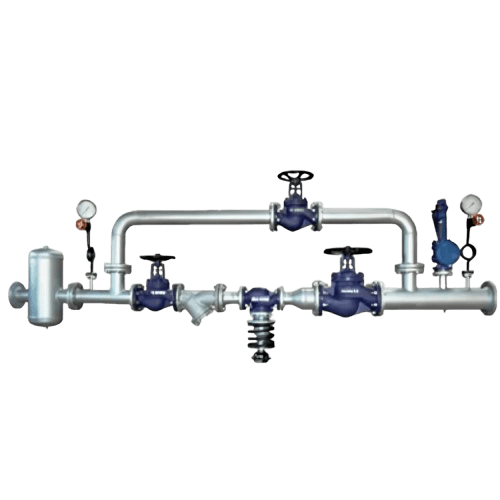
Main Components of a Steam PRV Station
Pressure Reducing Valve
The pressure reducing valve is the principal component of the station. It regulates steam flow and maintains the required downstream pressure.
Depending on the application, self-operated pressure reducing valves or externally controlled pressure control valves may be used. Selection depends on flow range, pressure ratio, steam temperature, response requirements, and control accuracy.
Isolation Valves
Isolation valves are installed upstream and downstream of the pressure reducing valve. They allow maintenance personnel to isolate the station without shutting down the entire steam distribution network.
Gate valves, ball valves, or other suitable isolation valves may be selected according to the piping specification.
Strainer
A steam strainer removes foreign particles and debris from the steam line before they reach the pressure reducing valve. This helps protect internal components and improve valve reliability.
Safety Relief Valve
A safety relief valve is an important part of many steam pressure reducing stations. If the downstream pressure rises above the permissible limit due to regulator failure or another abnormal condition, the safety valve can provide overpressure protection.
The relief valve must be sized and set according to the applicable engineering requirements.
Pressure Gauges and Transmitters
Pressure instrumentation allows operators and control systems to monitor upstream and downstream pressure.
A typical arrangement may include:
- Upstream pressure gauge
- Downstream pressure gauge
- Pressure transmitter
- Temperature transmitter
- Flow measurement where required
Importance of Steam Pressure Reducing Valve Selection
Selecting the correct steam pressure reducing valve requires more than comparing inlet and outlet pressure.
Engineers should consider:
- Maximum steam flow
- Minimum steam flow
- Normal steam flow
- Inlet pressure
- Outlet pressure
- Steam temperature
- Pressure differential
- Pipe size
- Valve size
- Noise generation
- Cavitation or erosion considerations
- Required control accuracy
- Fail-safe requirements
Oversizing a pressure reducing valve can result in poor control at low flow, while undersizing can cause excessive pressure drop and insufficient steam capacity.
Steam Pressure Reducing Station for Industrial Plants
Different industries have different requirements.
In pharmaceutical plants, steam pressure control is important for sterilization, clean steam systems, and controlled heating applications.
Food and dairy facilities use steam for cooking, pasteurization, cleaning, and process heating.
Chemical and petrochemical plants use steam across reactors, heat exchangers, reboilers, tracing systems, and utility networks.
Textile plants may use steam for dyeing, drying, finishing, and other thermal processes.
Power plants use multiple pressure levels for auxiliary systems, feedwater heating, deaeration, and other services.
Design Considerations
A reliable steam PRV station manufacturer should consider the complete system rather than selecting the pressure reducing valve independently.
The station layout should provide sufficient straight pipe length, suitable access for maintenance, proper drainage, and adequate support. Condensate accumulation must be minimized because wet steam can contribute to erosion, water hammer, and poor pressure-control performance.
Thermal expansion, piping loads, insulation, noise, and vibration should also be considered during engineering.
Conclusion
A Steam Pressure Reducing Station provides controlled and reliable pressure reduction between different levels of a steam distribution system. Its performance depends on correct pressure reducing valve selection, appropriate isolation, filtration, instrumentation, safety protection, condensate management, and overall station design.
For industrial plants, a properly engineered steam pressure reducing valve station can improve process stability, protect downstream equipment, and support efficient steam distribution. Selecting a technically competent manufacturer and designing the complete assembly according to operating conditions is essential for safe and dependable performance.

 English
 Arabic
 French
 Spanish
 Portuguese
 Deutsch
 Turkish
 Dutch
Dutch
 Italiano
 Romaian
 Portuguese (Brazil)
 Tiếng Việt