
Why Thermal Retrofits Are Becoming Critical Across Europe
A major shift is underway across Europe’s heating and power infrastructure as asset owners seek practical ways to improve performance without compromising reliability. Aging equipment, changing electricity markets, renewable integration, and environmental expectations are encouraging a more flexible approach to thermal investment. CHP modernization, responsive gas generation, and targeted retrofits are becoming complementary tools within this transition.
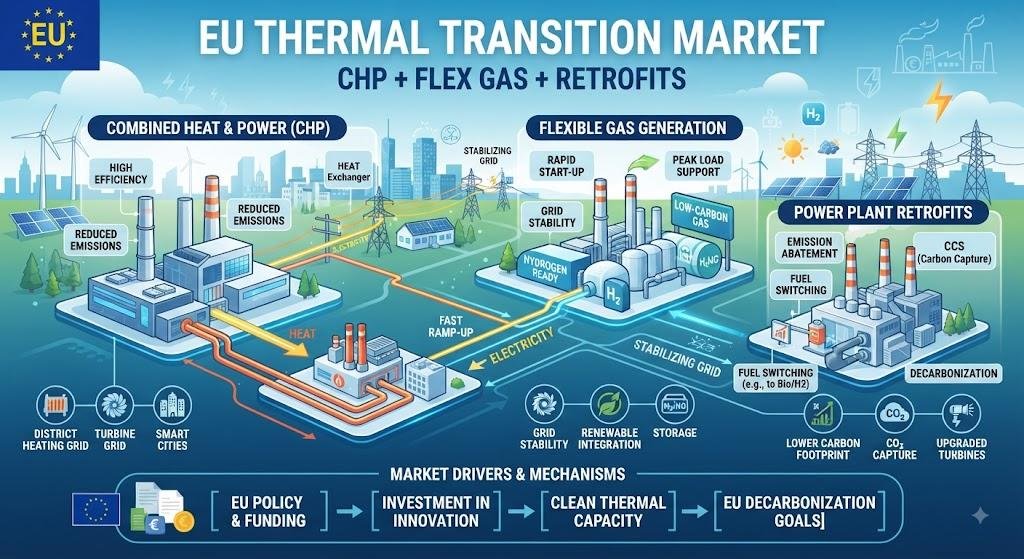
CHP systems can remain valuable when facilities have substantial and predictable heat requirements. By producing electricity and useful heat together, they can reduce losses associated with separate generation and support local energy resilience. Modern upgrades can improve combustion efficiency, heat recovery, automation, and maintenance performance. When paired with thermal storage, CHP can also operate more strategically instead of simply following a fixed production schedule.
Flexible gas generation addresses another challenge: electricity supply is becoming more variable as renewable capacity expands. Fast-start engines and turbines can provide dependable capacity when wind or solar production changes unexpectedly. Their role is particularly relevant in systems where grid flexibility is limited or where industrial users require continuity. Future investment decisions will increasingly consider whether these assets can adapt to evolving fuel and emissions requirements.
Retrofits offer a lower-disruption pathway for improving older plants. Many facilities can gain meaningful efficiency benefits through better insulation, upgraded burners, heat recovery, modern pumps, improved steam systems, and digital controls. These projects can be implemented in stages, allowing operators to prioritize equipment with the largest performance gaps. Phased investment can also reduce operational disruption and make capital planning easier.
Energy efficiency is becoming more valuable because thermal users face pressure from several directions at once. Fuel prices can fluctuate, electricity costs can change rapidly, and carbon-related expenses can influence operating decisions. Reducing energy consumption therefore provides both an economic and strategic advantage.
Digital technologies are helping unlock these gains. Real-time monitoring can identify inefficient operating conditions, while analytics can compare performance across equipment and operating periods. Predictive maintenance can reduce unplanned outages by identifying signs of equipment degradation. Automated optimization can coordinate generation, heat production, storage, and demand according to changing conditions.
Financing will influence how quickly modernization occurs. Some asset owners may prefer direct capital investment, while others may consider energy-as-a-service arrangements or performance contracts. The availability of financing can determine whether projects focus on small efficiency improvements or comprehensive plant upgrades. Financial models that recognize energy savings and resilience benefits can make modernization more attractive.
The supply chain is also evolving. Manufacturers are improving equipment efficiency and controls, engineering companies are designing integrated systems, and service providers are supporting long-term operation. This creates a broader ecosystem around thermal modernization.
Regional conditions remain decisive. A district heating operator has different needs from a chemical plant or a large commercial building. Local electricity prices, fuel availability, grid constraints, emissions rules, and heat demand patterns can all change the economics of a project. Successful developers will therefore need localized assessments rather than one standardized solution.
Companies evaluating Europe Thermal Transition (CHP + Flex Gas + Retrofits) Market Size can use these factors to understand the scale and direction of investment opportunities. The market is increasingly defined by modernization rather than simple capacity expansion.
The strongest strategy may be a staged pathway. Operators can begin with energy audits and digital monitoring, prioritize high-return retrofits, modernize CHP equipment where justified, and add flexible generation or storage when system conditions support it. This approach reduces uncertainty while creating measurable improvements.
Europe’s thermal transition will ultimately depend on assets that can perform efficiently under changing conditions. Combining proven thermal technologies with smarter controls, selective investment, and future-ready planning can help organizations maintain reliability while steadily moving toward cleaner and more adaptable energy systems for operators.

 English
 Arabic
 Spanish
 Portuguese
 Deutsch
 Turkish
 Dutch
Dutch
 Italiano
 Russian
 Romaian
 Portuguese (Brazil)
 Tiếng Việt