
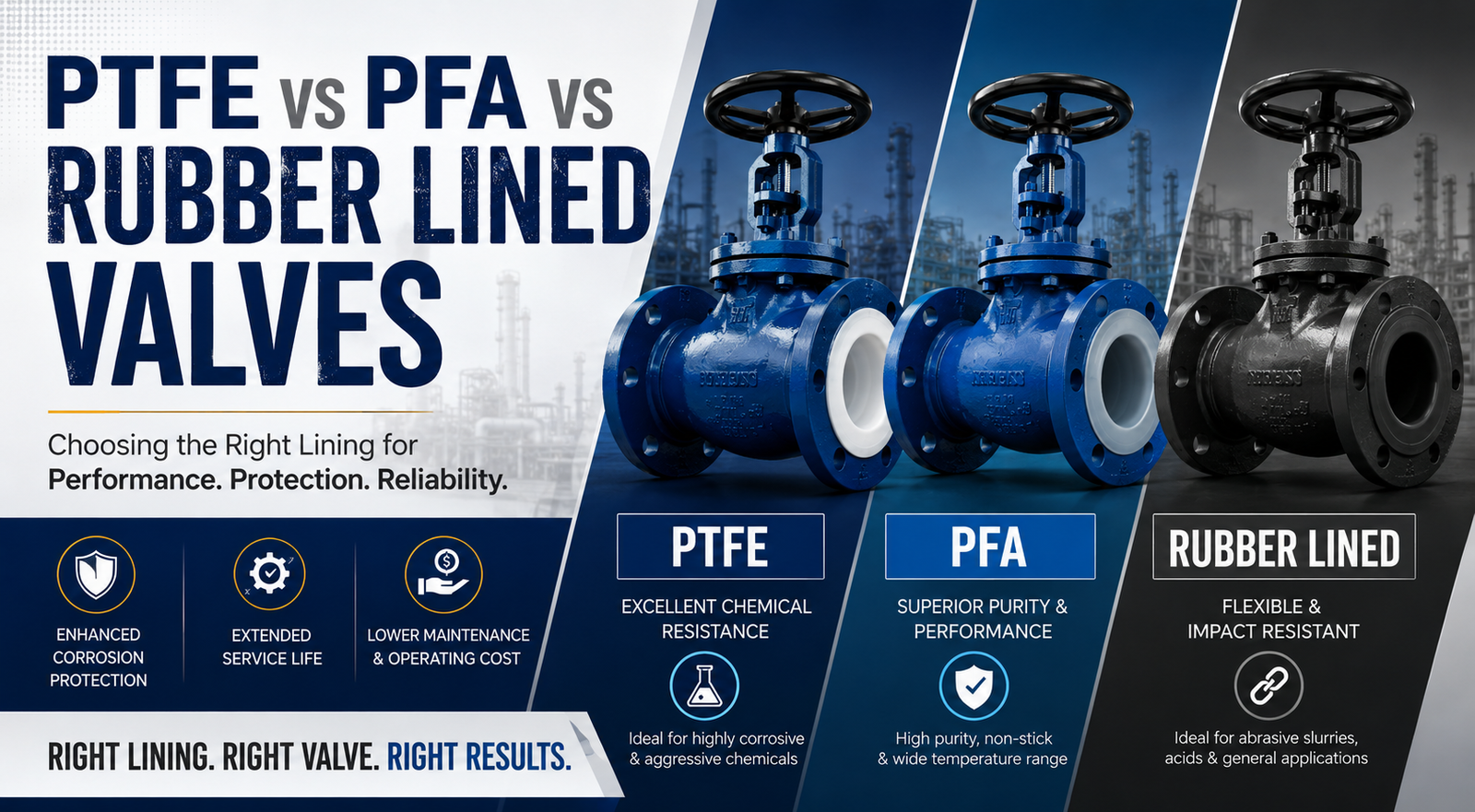
Once a plant decides that a lined valve is the right solution for a corrosive or abrasive application, the next question is almost always: which lining material is right for this specific job? With PTFE, PFA, FEP, and rubber all commonly available, and each offering different strengths in temperature tolerance, chemical resistance, and abrasion handling, choosing the wrong lining can mean early failure even though "lined valves" were correctly specified in principle. This guide breaks down how each lining material performs, and which industries and applications each one suits best, so you can make a confident, informed purchase decision.
Why Lining Material Selection Matters
A lined valve is only as good as the match between its lining and the process conditions it faces. Two valves that look identical on the outside can behave completely differently in service if one is lined with standard PTFE and the other with PFA, simply because of differences in temperature rating, permeability, and mechanical flexibility. Getting this decision right the first time avoids premature valve replacement, unplanned downtime, and the safety risks that come with an unexpected lining breach.
PTFE Lined Valves
Polytetrafluoroethylene (PTFE) is the most widely used lining material in the industry, prized for its near-universal chemical resistance — it withstands almost every acid, alkali, and solvent used in industrial processing. PTFE-lined valves also has excellent non-stick and low-friction properties, which helps prevent scaling and sticking in valves that operate intermittently.
- Best for: general chemical processing, pharmaceutical intermediates, acid and alkali transfer lines
- Strengths: outstanding chemical inertness, low friction, cost-effective
- Limitations: slightly more prone to permeation and cold flow under sustained mechanical stress compared to PFA
PFA Lined Valves
Perfluoroalkoxy (PFA) shares PTFE's chemical resistance but offers better mechanical strength, lower permeability, and a higher usable temperature range in many valve designs. This makes PFA a preferred choice for more demanding or higher-temperature chemical processes, as well as applications where a smoother, more consistent lining surface is required.
- Best for: high-temperature chemical processes, pharmaceutical API synthesis, critical isolation duty
- Strengths: superior high-temperature performance, lower permeability, longer service life in demanding conditions
- Limitations: typically a higher upfront cost than standard PTFE linings
FEP Lined Valves
Fluorinated Ethylene Propylene (FEP) offers chemical resistance similar to PTFE with somewhat easier manufacturability for complex shapes, making it a practical option for certain valve geometries. It's commonly used where moderate temperatures and broad chemical compatibility are the main requirements.
- Best for: general-purpose corrosive service where PTFE-level resistance is needed
- Strengths: good chemical resistance, smooth finish
- Limitations: generally rated for lower maximum temperatures than PFA
Rubber Lined Valves
Unlike fluoropolymer linings, rubber linings (natural rubber, neoprene, or specialized elastomer compounds) are chosen primarily for their abrasion resistance rather than broad chemical compatibility. This makes them a strong fit for slurry, sludge, and mineral processing applications where suspended solids — not aggressive chemicals — are the main threat to valve life.
- Best for: mining slurries, water and wastewater sludge lines, mineral processing
- Strengths: excellent abrasion resistance, good flexibility, cost-effective for slurry duty
- Limitations: more limited chemical resistance range compared to PTFE or PFA
Matching Lining Material to Your Industry
| Industry | Typical Lining Choice |
|---|---|
| Chemical Processing | PTFE / PFA |
| Pharmaceutical | PTFE / PFA |
| Water & Wastewater Treatment | PTFE / Rubber |
| Fertilizer & Mining | PTFE / Rubber |
| Metal Pickling & Surface Treatment | PTFE / PFA |
This table is a general starting point — actual selection should always account for specific chemical concentration, operating temperature, pressure rating, and abrasive content in your process stream.
Questions to Ask Before You Buy
- What is the exact chemical composition and concentration of the media?
- What is the maximum operating temperature and pressure?
- Does the stream carry suspended solids or abrasive particles?
- How frequently will the valve be actuated?
- What line size and end connection standard does your piping require?
Answering these questions before placing an order helps your supplier recommend the correct valve type — ball, butterfly, plug, diaphragm, or globe — along with the most suitable lining material and thickness.
Conclusion
Choosing between PTFE, PFA, FEP, and rubber linings isn't about which material is "best" in absolute terms — it's about which one matches your specific chemical, temperature, and abrasion profile. Getting this decision right the first time saves significant money and downtime over the life of your plant. Whether your application calls for PTFE, PFA, or rubber lined valves, you can buy Lined Valves at Freture Techno Pvt. Ltd., a Mumbai-based industrial valve manufacturer with over 18 years of experience helping process industries across India and international markets select and source the right lined valve solution for their exact operating conditions.

 English
 Arabic
 French
 Spanish
 Portuguese
 Deutsch
 Turkish
 Dutch
Dutch
 Italiano
 Russian
 Portuguese (Brazil)
 Tiếng Việt