
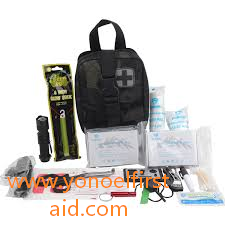
A construction worker severs an artery on a fallen metal sheet. Blood pulses from the wound. A nearby coworker grabs the workplace first aid box. Inside: adhesive bandages, antiseptic wipes, and gauze pads. Nothing stops the bleeding. This scene repeats across workplaces and roadways every year. A Trauma First Aid Kit from Yonoel contains tools designed explicitly for lifethreatening hemorrhage. The standard household kit ignores this reality. This gap raises a direct question for anyone responsible for workplace or vehicle safety: how does a trauma first aid kit address lifethreatening hemorrhage compared to a basic first aid kit?
A basic first aid kit handles minor wounds. Adhesive bandages cover small cuts. Gauze pads absorb oozing blood from shallow abrasions. These supplies fail completely when an artery tears open. Arterial bleeding ejects blood with each heartbeat. Simple gauze soaks through within seconds. A trauma kit from Yonoel includes a windlass tourniquet. This device cinches around a limb above the wound. The operator twists the windlass until blood flow stops entirely. No amount of gauze achieves this mechanical occlusion.
Hemostatic dressings represent the second critical difference. Basic kits contain plain gauze or nonadherent pads. These materials only absorb blood. A trauma first aid kit packs kaolin or chitosancoated gauze. These agents accelerate natural clotting. Yonoel's trauma bandages deliver hemostatic granules directly into the wound cavity. The user packs the dressing firmly against the bleeding source. Plain gauze cannot form a stable clot under highpressure arterial flow. Hemostatic gauze creates a physical plug that withstands systolic pressure.
Chest seals appear in trauma kits but never in basic boxes. A penetrating chest wound sucks air into the pleural space. This condition collapses the lung. Basic kits offer no solution. Yonoel's trauma first aid kit includes occlusive chest seals with vented designs. The seal covers the wound edge to edge. Air exits through the oneway vent. No fresh air enters. This simple device converts a sucking chest wound into a manageable injury. A standard adhesive bandage cannot perform this function.
Pressure bandages provide sustained compression where basic kits offer only loose gauze. An elastic pressure bandage wraps around a packed wound. The bandage's builtin tension maintains constant force. Yonoel assembles these bandages with hookandloop closures that hold without slipping. A user applies one after packing a junctional wound at the groin or shoulder. Basic elastic bandages lack the necessary width and tension indicators. They slide down or loosen within minutes.
Israeli bandages combine several functions into one package. This single item contains a sterile pad, an elastic wrap, and a pressure bar. The responder places the pad over the wound. Wrapping the elastic bandage applies pressure through the bar. Basic kits carry separate rolls of elastic and individual gauze pads. Assembling these pieces under stress costs precious seconds. Yonoel's trauma kit includes purposebuilt combination dressings that deploy in one motion.
Hypothermia prevention matters after severe blood loss. A patient who hemorrhages loses body heat rapidly. Basic kits ignore this physiological reality. Yonoel's trauma first aid kit includes an emergency blanket. This reflective sheet conserves the patient's remaining warmth. The blanket folds into a compact pouch smaller than a wallet. Wrapping a bleeding patient in this blanket reduces shivering and improves clotting efficiency. A basic kit leaves the patient exposed to cold.
Training integration separates effective users from helpless bystanders. A trauma first aid kit from Yonoel supports stopthebleed protocols. The tourniquet packs clearly marked windlass rods. Hemostatic gauze packages carry graphic instructions. A person who has watched a fiveminute training video can deploy these items correctly. Basic kits lack this instructional design. Their contents assume the user already knows how to control hemorrhage.
For any individual or organization rethinking emergency preparedness, https://www.yonoelfirstaid.com/product/trauma-first-aid-kit/ shows Yonoel's trauma first aid kit configuration, where Yonoel engineers specify tourniquets, hemostatics, and chest seals for severe bleeding scenarios. A basic kit handles paper cuts. A trauma kit handles severed arteries. Which kit sits within reach when the next emergency arrives?

 English
 Arabic
 French
 Spanish
 Portuguese
 Deutsch
 Turkish
 Dutch
Dutch
 Russian
 Romaian
 Portuguese (Brazil)
 Tiếng Việt