
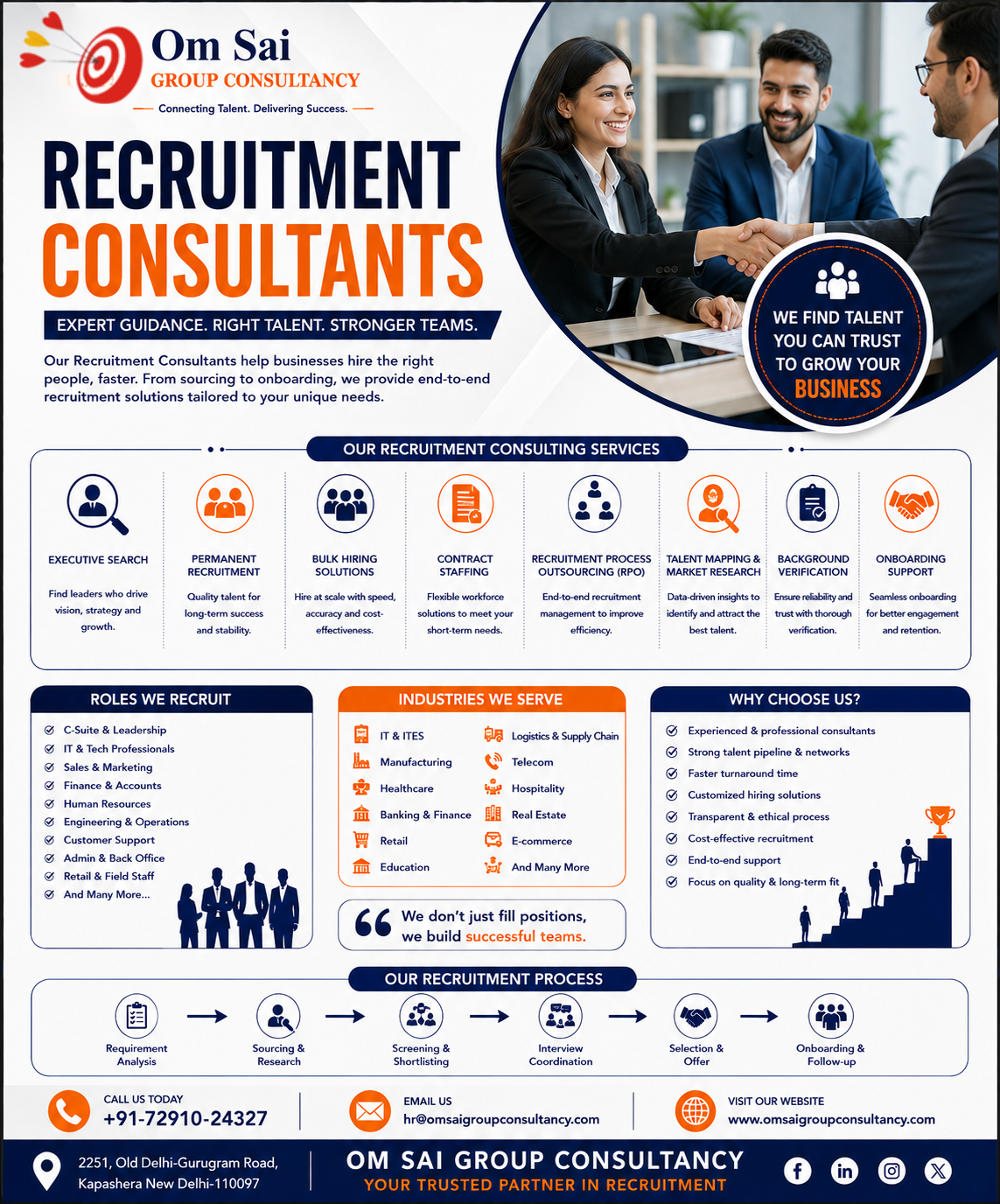
Recruitment consultant connect companies and qualified personnel. They comprehend a company’s hiring needs, recognize and evaluate candidates, and aid in the completion of the hiring process. They ease the stress of finding and evaluating candidates.
The hiring process has become increasingly complex, particularly for companies experiencing rapid growth and requiring mass hiring. Professional recruitment services assist businesses in fulfilling their hiring needs.
A Recruitment Consultant is an individual who assists a company in fulfilling their hiring goals by sourcing and evaluating candidates for available positions within the organization.
Unlike waiting for interested candidates to apply for a job opening, Recruitment Consultants take initiative and proactively look for candidates through various resources. Some of these resources may include their personal contacts, professional groups, and online job forums.
Before a recruitment process can commence, a Recruitment Consultant must first identify the specifics of the position for which they are hiring, for instance:
The job duties
The educational and experiential qualifications
The skills (Interpersonal and behavioral)
The financial remuneration
The workplace
The first user of the service (boss)
The industry
The headquarters and satellite offices
The management level
The hiring quota
With the above information, Recruitment Consultants are able to devise a strategy to source and evaluate candidates.
Why Companies Outsource Recruitment
When responsibilities of HR teams are not adequately managed, recruitment can easily become time consuming and difficult. When an application is submitted, HR has to screen it, invite the candidate for an interview, conduct the interview, follow up on the status of the position, and maintain the hiring records.
By outsourcing recruitment, HR can focus on core HR functions, and managers can focus on core business functions.
The end goal of a recruitment process is not to identify the largest applicant pool. The process aims to zero in on the most suitable candidates for the role.
How Does Recruitment Process Work?
The process starts with the Recruitment consultant understanding the employer’s specific needs.
- Understanding Employer’s Needs
A Recruitment consultant works closely with the employer to understand the role, responsibilities, and requirements of the position being hired.
Understanding the employer’s and the role’s specifics helps the consultant identify the most suitable candidates.
If the role is that of a production manager for an automobile company, the qualifications and experience required and the role of the hiring company will vary drastically from the requirements for hiring a software developer for a company in the IT sector.
- Identifying Potential Candidates
After requirements are analyzed and understood, the Recruitment consultant sets out to find qualified candidates for the role.
Which sources the consultant utilizes to find candidates depends on the nature of the role.
If the position is that of a CEO, it may be difficult to identify and recruit qualified candidates through traditional means. The recruiter may have to rely on his/her professional network to find qualified candidates.
- Evaluating Candidates
A large and qualified applicant pool does not necessarily mean that a large number of qualified candidates have applied for the role.
Recruitment consultants identify aspects of a candidate’s profile that are relevant to the employer’s requirements. While doing this, they may consider the candidate’s level of experience, qualifications, the industry, the candidate’s skills, where the candidate is located, what level of compensation the candidate expects, and the candidate’s overall availability.
Having considered these aspects of a profile, the recruitment consultant is able to develop a shortlist of candidates who have been deemed most suitable for a role.
- Candidate Evaluation
In order to further evaluate candidates, recruitment consultants typically conduct telephone interviews. During these telephone interviews the consultant is able to assess how well the candidate’s expectations align with the job opportunity.
There are a number of areas that the consultant may evaluate including, but not limited to, the candidate’s experience and service, the candidate’s salary expectations, the notice period, where the candidate is located, and the candidate’s interest in the job opportunity.
telephonic evaluation of candidates often leads to the conclusion that an candidate need not be evaluated further.
- Interview Coordination
Upon identifying candidates who are most suitable for the role, the recruitment consultant is able to facilitate the employer’s interaction with the candidate at various stages, including the interview.
The recruitment consultant may also coordinate various activities that take place between the employer and candidate following the interview, including offering and on-boarding the candidate.
Support during these stages of the recruitment process is very valuable to the employer and helps the employer maintain a smooth flowing recruitment process.
Offering and on-boarding may take place, for example, when the candidate has withdrawn from further consideration, or when the candidate has received a better job offer and joined another employer.
Recruitment consultancy is valuable to employers for many reasons, including the fact that the recruitment consultancy firm is able to expedite the finding of a suitable candidate for a job opportunity.
Because of the recruitment consultancy firm's extensive recruitment and placement network, the firm may be able to satisfy a client employer’s need for an employee in the shortest time.
Due to the firm’s extensive experience, the recruitment consultancy firm may be able to locate the candidate who best meets the employer’s needs, even if the candidate is not actively looking for a job.
Recruitment companies with established sourcing networks can help employers reach professionals not likely to find the opportunity through public job postings.
Less Work for the Internal Team
Recruitment is a time-consuming and resource intensive activity. The HR team spends valuable time performing numerous recruitment related activities such as calling, screening, and following up.
By outsourcing part of the recruitment process, the HR team is freed up to concentrate on other employee-related activities.
Bulk Hiring
A start up, or a company opening a new branch, or a company expanding its operation and workforce can inevitably result in hundreds of vacancies.
A Recruitment consultant can assist the company by developing a system to structure the hiring process to meet the company’s hiring requirements.
Specific Industry Recruitment
There are variations in the nature of hiring in different industries.
For example, the nature of hiring in the IT industry can be totally different from hiring in Healthcare or Manufacturing Industry.
In addition to varying the skills and experience required for a particular role, each industry has its own recruiting standards and best practices. Recruitment consultants, with industry knowledge and experience, can identify the skills and experience required for a role in that industry.
Recruitment Consultant vs Internal HR
A Recruitment consultant is an ally to the Internal HR department. In addition to recruitment, a Consultant can assist the department with other work related to the employee life cycle. When a recruitment peak is not sustained, the Internal HR department can always rely on the recruitment consultants’ expertise and experience for candidate sourcing and recruitment.
When is it Appropriate to Seek Recruitment Assistance?
Not all vacancies warrant engagement of a third party for recruitment assistance. However, there are conditions which dictate the need for professional recruitment assistance.
These include:
Persistent vacancies
When the HR team is overwhelmed and unable to keep up with the company’s recruitment requirements.
When the organization is looking to recruit experts in specialised fields.
When the company needs to recruit managers and leaders.
When there are peaks in the organization’s workforce requirements.
When the organization needs to recruit at different locations and/or simultaneously.
When the organization needs to recruit in record time.
When the organization requires a bigger and wider talent pool.
When the company is taking its business to a different geographic location.
When the organization’s recruitment team requires support in talent acquisition.
Under and within the aforementioned conditions, the organization must evaluate the level of diversity and the extent of the recruitment requirements.
How to Select the Ideal Recruitment Consultant
Price is not the only factor to be considered when selecting a recruitment consultant. Other factors such as the consultant’s experience, the recruitment process, the consultant’s industry and profession knowledge and understanding of the employer’s needs must be taken into consideration.
Evaluate the Recruitment Process
Consultants must explain the process they will use to evaluate and present candidates to the employer.
Consultants must be transparent to give the employer a clear understanding of the recruitment process.
Understand Candidate Quality
The quality and quantity of candidates must be evaluated.
A recruitment consultant must understand that an employer is interested in the quantity and relevance of the candidates and not the total number of resumes submitted.
Discuss the importance of communicating regularly when recruiting. The recruiting process requires consistent engagement from employers and an understanding of how frequently the recruiting consultant will communicate candidate status, interview schedule and results, feedback, offer letters, and the start date.
Recruitment for Expanding Companies
Challenges in recruitment are often occasioned by expansion of business. Success in the recruitment process is essential for the achievement of business growth plans.
An experienced recruitment consultant can guide the client through the entire process of expanding the business workforce by introducing a combination of best practices that include strategic methods and large scale recruitment process.
An organization can at the same time require a software professional, sales executive, finance professional, human resource professional, engineer, manager, supervisor, operational staff, etc.
Recruitment for Expanding Companies (Cont.)
If the organization has the capacity to absorb the new staff, the recruitment process for expansion can be complicated. The best practice for the organization in such a situation is to engage a recruitment consultancy firm that can handle the entire recruitment process and design a flexible sourcing strategy.
The Future of Recruitment Consultancy
Although recruitment is a people’s business, the industry is gradually adopting various recruitment technology. New trends in the market have created a situation where recruitment can be fully automated.
Recruitment Consultants should continuously re-strategize, use their professional judgment and exhibit flexibility to remain competitive in the industry. New ways of integrating technology in the recruitment process should be pursued to achieve excellent customer service. Ultimately, winning the trust of clients should be the major concern for all Recruitment Consultants.
Questions About Recruitment Consultants
What is the role of a recruitment consultant?
A recruitment consultant works with organizations to find and hire the right employees. A recruitment consultant performs a number of tasks from identifying jobs and candidates to reviewing resumes, to conducting telephone interviews, to organizing and coordinating face to face meetings with candidates.
What is the benefit of using a recruitment consultant?
Smaller organizations often do not have large recruitment functions and may find it useful to engage the services of a recruitment consultant. Recruitment consultants have an extensive candidate database and can be very useful for bulk hiring.
Are recruitment consultants flexible in the type of employees hired?
Recruitment consultants can be very flexible and recruit for various types of employees including permanent and temporary staff as well as contract staff and executives. Recruitment consultants can also provide workforce solutions including RPO.
What should a company consider when selecting a recruitment consultant?
Depending on the requirement of the organization, the company should evaluate the recruitment consultant’s experience in the relevant area, the process followed to assess candidates, the quality of candidates presented, the consultant’s office location, and the fees charged by the recruitment consultant.
Conclusion
The objective of an ideal employee search is not to simply put a body in a desk.
Recruitment consultants assist organizations by quickly and effectively meeting staffing requirements. Recruitment consultants often have a network of candidates that enables them to meet staffing needs for a variety of roles including specialist and management positions.
In order to attain recruitment excellence, employers must first gain clarity on the role, the skills required for the role and the target market for the role. Once clarity is attained, the recruitment process becomes a partnership to achieve the employers’ vision and sustain the business.
Employees are a business’ most valuable asset. Recruitment allows a business to build its team and expand. Employers who invest in a holistic people strategy allow their team to build sustainable business’ and continually fulfill their purpose.
Are you looking to hire? A recruitment partner can assist with recruitment activities to increase your talent pool and build your workforce.

 English
 Arabic
 Spanish
 Portuguese
 Deutsch
 Turkish
 Dutch
Dutch
 Italiano
 Russian
 Romaian
 Portuguese (Brazil)
 Tiếng Việt