
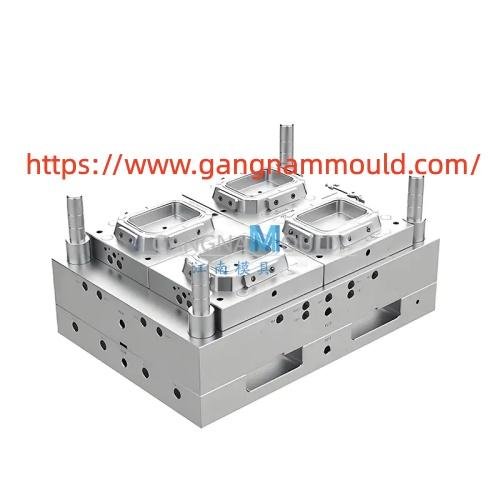
Buck Basket Injection Mould selection should begin with the actual product requirements rather than only the tooling quotation. Buyers need to consider basket dimensions, wall thickness, opening patterns, handle structure, material, production quantity, machine compatibility, cooling, and ejection before approving a design. Open basket products often contain grids, ribs, corners, and repeated openings, so the relationship between product geometry and tooling structure deserves careful attention. Gangnammould describes its basket and tray tooling as being designed around factors such as structural integrity, weight, ventilation patterns, filling, cooling, and dimensional consistency.
The product drawing is the first document buyers should review with the engineering team. Overall length, width, height, bottom structure, handle dimensions, stacking features, and ventilation openings should be clearly defined. If the basket is intended for agricultural, household, retail, or logistics use, its working conditions should also be explained. A basket used for lightweight household storage may have different requirements from one designed for repeated handling or transportation.
Wall thickness is another important consideration. A basket with many thin sections and openings can present different filling and cooling conditions from a solid container. Large variations in section thickness may contribute to uneven cooling, shrinkage, or deformation. Injection molding design guidance generally recommends paying close attention to wall thickness because it affects filling, cooling, dimensional stability, and cycle conditions. Buyers can therefore ask whether the proposed product design has been reviewed for manufacturability before steel processing begins.
The ventilation pattern also deserves attention. Many plastic baskets rely on openings to reduce weight and allow air circulation. However, these openings need to work together with ribs and connecting sections so that the finished item has the required structural behavior. The size, spacing, corner transitions, and surrounding material can all influence how the plastic flows into the cavity. Gangnammould notes that basket tooling commonly considers wall thickness, ventilation holes, structural strength, and customization of size and pattern.
Material selection should be discussed at an early stage as well. Polypropylene and polyethylene are commonly used for plastic baskets, but the actual resin grade can vary according to impact requirements, flexibility, stiffness, appearance, temperature conditions, and intended use. Material properties can affect shrinkage, flow behavior, gate selection, cooling requirements, and final dimensions. Buyers should provide the expected resin information so that the tooling design can be evaluated against realistic processing conditions.
Cooling is particularly important when the product contains numerous ribs, narrow sections, deep areas, or a tall core. Uneven temperature control can influence deformation and dimensional consistency. Research and industry guidance both emphasize that thermal management is closely connected with molding stability. For basket tooling, the cooling layout may need to account for the cavity, core, and other areas where heat is more difficult to remove. Buyers can ask for a cooling circuit plan and discuss access for cleaning and maintenance before the tooling is completed.
The filling system should also be evaluated according to the basket structure. Gate position can influence how the material reaches different sections of the cavity. With an open grid pattern, the flow may need to travel through multiple connected areas, so the engineering team should consider filling balance and potential weld line locations. For larger products or particular production targets, a hot runner system may be considered, while other designs may use a conventional runner arrangement. The choice should be based on product geometry, resin, equipment, production quantity, and project budget rather than a fixed approach.
Ejection is another point buyers should not overlook. Once the part has cooled, it needs to separate from the core without unnecessary stress or deformation. A basket may have many ribs and internal features that create contact areas between the molded part and tooling. The ejection arrangement should therefore be planned around these features. Depending on the structure, ejector pins, stripper systems, lifters, or other mechanisms may be considered.
Steel selection should correspond with the expected production conditions. Buyers should discuss production quantity, resin characteristics, surface requirements, corrosion considerations, and maintenance expectations when reviewing steel grades. They can also request information about guide components, inserts, wear areas, and replaceable parts. Clear documentation can make later maintenance and component replacement easier to organize.
Machine compatibility is equally practical. The tooling needs to fit the available injection molding equipment in terms of clamping capacity, platen dimensions, mold height, opening stroke, injection capacity, and ejection configuration. Providing the machine specification before detailed design begins gives engineers a better basis for planning the tooling structure. This step can also reduce the possibility of discovering equipment limitations after manufacturing has started.
Production volume should influence the tooling strategy. A customer producing a few batches each year may have different requirements from a manufacturer running continuous orders. Buyers should communicate expected annual output, desired cycle conditions, cavity quantity, automation plans, and possible future variations. Multi cavity tooling can be considered when the production target and product size make it practical. Gangnammould also discusses multi cavity basket tooling as one option for producing multiple baskets within a molding cycle.
Testing and acceptance requirements should be agreed before trial production. Buyers can prepare specifications covering dimensions, weight, appearance, opening accuracy, stacking performance, handle strength, flash, warpage, and other functional details. Sample inspection becomes much easier when both sides are working from the same criteria.
Maintenance planning should also be part of the purchasing discussion. Buyers can ask about cleaning, lubrication, cooling connections, inspection points, spare components, and recommended maintenance intervals. Easy access to service areas can be useful when the tooling enters regular production.
A thoughtful purchase decision should connect product design, material, production volume, equipment, tooling structure, testing, and maintenance into one practical plan. Gangnammould provides customized plastic basket tooling for different sizes, patterns, and applications, giving buyers a starting point for discussing specific project requirements. To review related mould manufacturing capabilities and product options, visit https://www.gangnammould.com/product/

 Arabic
 French
 Spanish
 Portuguese
 Deutsch
 Turkish
 Dutch
Dutch
 Italiano
 Russian
 Romaian
 Portuguese (Brazil)
 Tiếng Việt