
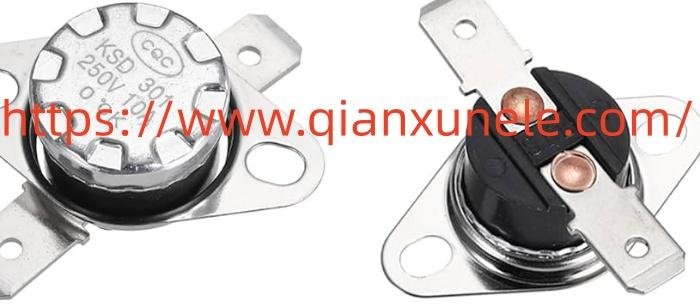
KSD 301 Steam Iron Thermostat selection should begin with the complete appliance design rather than a single specification. Buyers should consider the required temperature range, electrical load, mounting space, connection structure, heat transfer path, reset behavior, operating cycles, and production requirements. Looking at these factors together can help manufacturers select a thermal control component that fits their intended appliance structure and manufacturing process.
Start With the Actual Heating Requirement
Every appliance has its own heating characteristics. The heating element, metal plate, insulation materials, housing structure, and control circuit can influence how temperature develops during operation.
Before contacting a supplier, buyers should identify the normal working temperature and the point where the heating circuit needs to change its electrical state. They should also determine the acceptable temperature difference between activation and recovery.
Having these values prepared can make communication with a manufacturer more efficient and reduce uncertainty during the selection stage.
Check the Electrical Working Conditions
Electrical compatibility should be reviewed before mechanical details are finalized. Buyers need to consider rated voltage, current, contact arrangement, circuit structure, and the type of heating element connected to the component.
The selected rating should correspond with the actual appliance circuit. If a manufacturer produces several models, each model should have its own component specification list to prevent incorrect matching during assembly.
It is also useful to discuss expected electrical cycling with the supplier, especially when the appliance will operate frequently throughout its service period.
Measure the Available Installation Space
A thermal component may have suitable electrical and temperature characteristics but still be difficult to install if its physical dimensions do not match the appliance.
Buyers should measure the available space before ordering. Important dimensions can include body diameter, body height, mounting hole position, terminal location, fixing distance, and surrounding clearance.
The position of nearby wires and other components should also be checked. A detailed dimensional review at the design stage can reduce modifications later in the assembly process.
Pay Attention to Heat Transfer
Temperature sensing depends on how heat reaches the sensing element. The contact area, mounting pressure, surface condition, and position relative to the heating source can all influence thermal response.
Manufacturers should therefore consider the entire heat path rather than examining the component separately.
If the thermal component is installed too far from the monitored surface, the response may not correspond closely with the actual temperature. If the mounting arrangement creates excessive thermal transfer, the switching behavior may also differ from the intended design.
For new appliance development, sample testing can help engineers evaluate the actual relationship between the heating surface and the sensing position.
Compare Reset Characteristics
The reset method is another important purchasing consideration. Depending on the appliance design, buyers may require automatic recovery after cooling or a configuration that requires manual intervention.
The choice should be connected with the intended operating sequence. A product designed for repeated heating cycles may require a different recovery behavior from an appliance where thermal protection is intended as a separate safety measure.
Buyers should communicate the expected cycle clearly and confirm the required reset characteristics before production.
Review Terminal Design
Terminal configuration can affect both electrical connection and assembly efficiency. Buyers should check terminal direction, size, shape, connection method, and compatibility with existing wiring.
A suitable terminal structure can simplify assembly and reduce unnecessary changes to the appliance circuit.
For large-volume manufacturing, consistency in terminal dimensions is also useful because automated or semi-automated assembly equipment may depend on fixed component positions.
Consider the Operating Environment
Temperature control components can operate inside areas exposed to heat, moisture, vibration, and repeated temperature changes. Buyers should therefore consider the actual environment surrounding the component.
The housing material, insulation structure, terminal material, and mounting method should correspond with the appliance environment.
Manufacturers should also consider whether the component will be exposed to condensation or other environmental conditions during normal operation. These details are worth discussing before finalizing the specification.
Evaluate Production Consistency
For appliance manufacturers, purchasing one suitable sample is only the beginning. The supplier should also be capable of maintaining consistent specifications during larger production runs.
Buyers can ask how temperature characteristics are checked, how dimensions are controlled, and how electrical performance is inspected.
A useful supplier evaluation can include sample comparison, batch inspection records, technical drawings, production information, and quality documentation. These materials can help purchasing and engineering teams assess whether a component is suitable for repeated production.
Ask About Custom Requirements
Standard specifications may not fit every appliance structure. Some projects may require different temperature settings, terminal arrangements, mounting dimensions, connection structures, or other design details.
Manufacturers should provide clear technical information when discussing customization. Drawings, target parameters, expected quantity, operating conditions, and application requirements can help the supplier understand the project more accurately.
For new appliance development, requesting samples before mass production can give engineers an opportunity to verify installation, electrical connection, temperature response, and assembly compatibility.
Compare the Supplier as Well as the Product
Price should not be the only factor when comparing manufacturers. Buyers should also review production capability, technical communication, customization support, inspection procedures, sample services, delivery planning, and after-sales communication.
qianxunele can be considered by manufacturers that need thermal control components for household appliance applications. A direct discussion with the supplier can help buyers clarify technical requirements before selecting a production configuration.
A clear comparison process can make purchasing decisions easier because each potential supplier is evaluated using the same criteria instead of relying only on product photographs or a single quoted price.
Plan for Long Term Supply
For manufacturers with continuing production requirements, supply planning deserves attention before the initial order. Buyers can discuss expected annual demand, standard packaging, lead time arrangements, replacement requirements, and future specification changes.
Keeping the same technical standards across repeated orders can simplify quality inspection and production management.
For manufacturers looking for suitable thermal control components, qianxunele provides product options that can be reviewed through the https://www.qianxunele.com/product/ Buyers can compare technical requirements, installation conditions, electrical characteristics, customization possibilities, and supply arrangements before moving from sample evaluation to larger production orders.

 English
 Arabic
 French
 Spanish
 Portuguese
 Turkish
 Dutch
Dutch
 Italiano
 Russian
 Romaian
 Portuguese (Brazil)
 Tiếng Việt