
Batch and specialty chemical plants pack more local pressure indication into less floor space than almost any other process industry — reactor vessels, jacketed lines, and utility headers each carry their own pressure gauge or switch, and most of those tie-ins never need anything more elaborate than block-and-equalize isolation. A 3 way manifold valve is what makes that instrumentation serviceable: two isolation valves and an equalizer let a technician pull a gauge for calibration or replacement mid-campaign, without draining the vessel or shutting the header down.
Typical Tie-In Points on a Chemical Plant
Reactor vessel pressure gauges, jacket-side pressure indication on heated or cooled vessels, and utility header gauges on steam, nitrogen, and compressed-air distribution are the most common 3 way manifold valve applications in a batch plant. Filtration and distillation skids add another cluster of tie-ins, where column and vessel differential pressure is watched locally as a fouling indicator even when the primary flow measurement runs through a separate DP transmitter loop elsewhere on the skid. Because these points are often clustered tightly around a skid or a vessel platform, remote-mount T and H type bodies — connected by a short length of tubing or small-bore pipe rather than mounted directly on the process nozzle — are the more common choice, keeping the gauge itself readable from the operator's normal walking path instead of buried against the vessel wall.
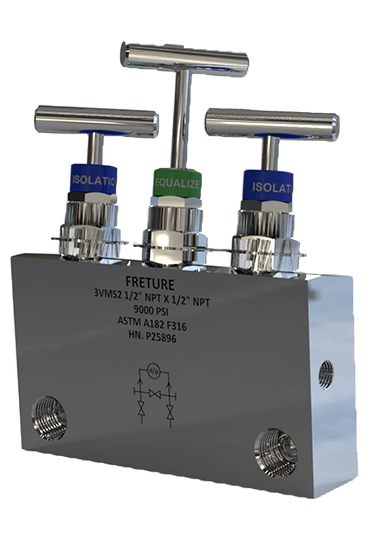
Choosing R, T, or H Type for Plant Instrumentation
The same three body patterns used across Freture's manifold range apply here. R type suits a gauge or switch mounted away from the tap and connected by tubing back to a local panel — common on reactor platforms where the tie-in point itself is hard to reach. T type gives a straight-through body for direct in-line mounting where clearance around the vessel or line allows it. H type shares one manifold body between two instruments at a single tie-in, useful where a gauge and a switch both need to read the same jacket or header pressure. The isolation and equalizing function is identical across all three; the decision comes down to how the plant's piping and platform layout dictate access.
Material Selection for Corrosive and Sour Duty
Where the process fluid is corrosive rather than simply hazardous, body and trim move beyond standard carbon or stainless steel to Alloy 20, Hastelloy, or PTFE-lined trim, selected against the specific chemical rather than a generic "corrosion-resistant" spec — a mismatch here is one of the more common causes of premature valve failure on a chemical plant. Where the stream is also sour or contains H2S as a byproduct, NACE MR0175/ISO 15156 material limits still apply on top of the chemical-compatibility requirement. Pressure-temperature ratings follow ASME B16.34, and shell/seat testing to API 598 is standard before a valve is accepted onto a plant's approved vendor list.
Servicing Instrumentation Without Stopping a Batch
The real value of a 3 way manifold valve on a batch plant is timing: a campaign that's mid-run can't always wait for a scheduled shutdown to replace a failed gauge. Closing both block valves and opening the equalizer lets the instrument come off the process safely while the batch continues, and because the manifold is a single compact body rather than a multi-piece assembly of individual valves and fittings, there are fewer joints to leak-check before the gauge goes back into service — a meaningful difference when a plant runs dozens of short campaigns a month rather than one continuous run. Documentation matters just as much as the hardware here: most chemical plants keep a materials-of-construction record for every wetted valve tied into a corrosive line, so mill certificates and API 598 test reports travel with the manifold from receiving inspection through to installation, not just at time of purchase.
Freture Techno manufactures 3 way manifold valves for chemical processing in stainless steel, Alloy 20, and other corrosion-resistant grades, tested to API 598 with NACE MR0175 options, for reactor, jacket, and utility-header instrumentation across batch and specialty chemical plants.

 English
 Arabic
 French
 Spanish
 Portuguese
 Deutsch
 Turkish
 Dutch
Dutch
 Italiano
 Russian
 Romaian
 Portuguese (Brazil)