
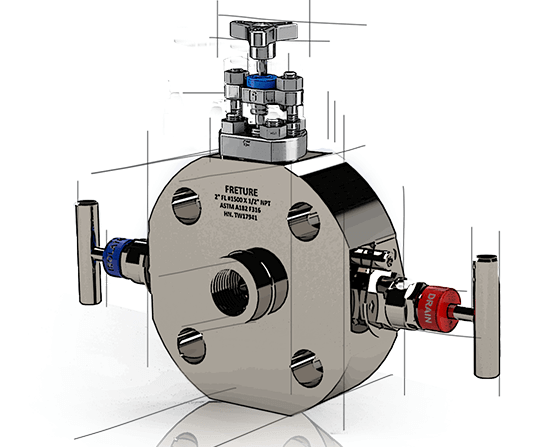
Offshore platforms, FPSOs, and subsea production systems operate under extreme space, weight, and safety constraints, and every extra flanged joint on a process line is a potential leak path. Monoflange valves solve this directly: a single forged body bolts straight onto the process flange and combines the isolation, equalizing, and venting functions that would otherwise need a multi-piece manifold built from several separate valves and pipe nipples. For pressure and differential pressure transmitters serving wellhead chokes, topside separators, and subsea tie-back metering skids, whether an engineer specifies a single, double, or triple monoflange valve comes down to what the instrument measures and how critical that reading is to safe operation.
Where Each Configuration Fits Offshore
A single monoflange valve gives one isolation valve for straightforward point measurements — wellhead pressure gauges, topside tank-level transmitters, and utility gas lines where redundancy isn't safety-critical. A double monoflange valve adds a second isolation valve plus an equalizing valve, and is the standard choice for differential-pressure flow transmitters reading across orifice plates or venturi meters on export and allocation metering skids, where a stable, drift-free DP signal drives custody-transfer accuracy. A triple monoflange valve builds in a vent or drain path on top of the double configuration, and is specified on subsea Christmas trees and safety-instrumented DP loops where the transmitter must be isolated, equalized, and depressurized without breaking into the primary process line — a real advantage when every offshore intervention costs vessel time and, subsea, may require a remotely operated vehicle.
Typical Offshore and Subsea Tie-In Points
Monoflange valves show up at most instrument taps across a producing asset: topside process separators and slug catchers, wellhead choke and kill lines, subsea manifold and Christmas tree DP taps, FPSO produced-water and export metering skids, and umbilical termination assemblies feeding topside control systems. On brownfield platforms, replacing a bulky multi-valve manifold with a single monoflange body is also a common way to reclaim deck space during instrumentation upgrades, without rerouting the process line itself.
Sour Service and Hazardous Area Compliance
Offshore and subsea production frequently handles H2S-bearing crude and gas, so monoflange bodies, bolting, and trim rated for this duty are qualified to NACE MR0175/ISO 15156 sour-service limits, with NACE MR0103 applied where relevant. Pressure-temperature ratings follow ASME B16.34, flange-to-flange dimensions align with ASME B16.5 for topside connections or API 6A/API 17D profiles for wellhead and subsea tree tie-ins, and fire-safe design is verified to API 607 or API 6FA for modules in classified hazardous areas. Shell and seat testing to API 598 is standard practice before any valve ships to an offshore site, where re-testing after installation is far more disruptive than at a shore base.
Material and Configuration Selection
Body material typically moves from carbon steel (A105) to low-temperature carbon steel (LF2) or duplex and super-duplex stainless as exposure moves toward the splash zone or subsea seabed, where chloride-driven corrosion resistance outweighs raw cost. Compact forged construction under API 602 keeps topside skid weight down, and an integral block-and-bleed vent lets technicians calibrate a DP transmitter without shutting in a well — an operational advantage that grows more valuable the further offshore, and the deeper subsea, the tie-in point sits.
Selection Checklist for Offshore Projects
Before finalizing a monoflange valve specification for an offshore or subsea package, EPCs and operators typically confirm: pressure class and flange rating against ASME B16.34/B16.5 (or API 6A/17D for subsea), body and trim material against the sour-service and splash-zone corrosion requirements, single/double/triple configuration against the instrument's function (point measurement, DP flow, or live-isolation duty), fire-safe qualification for the hazardous area classification, and end-user documentation — mill certificates, NACE compliance statements, and API 598 test reports — matching the project's material traceability requirements.
Freture Techno manufactures single, double, and triple monoflange valves in forged carbon steel, low-temperature steel, and duplex/super-duplex grades, tested and documented to API, ASME, and NACE requirements for offshore and subsea instrumentation isolation duties, with material traceability and third-party inspection available to EPC and operator specifications.

 English
 Arabic
 French
 Spanish
 Portuguese
 Deutsch
 Turkish
 Italiano
 Russian
 Romaian
 Portuguese (Brazil)
 Tiếng Việt