
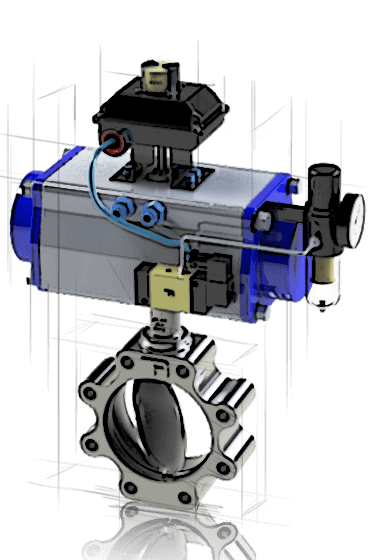
Butterfly valves are compact, lightweight, quarter-turn valves used across an enormous range of pipe sizes and industries — from municipal water lines to high-pressure hydrocarbon service. Their simplicity is the appeal, but the seat and disc design chosen behind that simplicity determines whether a given valve is suited to the job.
How a Butterfly Valve Works
A disc mounted on a shaft rotates 90° within the pipe bore, sealing against a resilient or metal seat when closed and swinging clear of the flow path when open. That short quarter-turn stroke, combined with a compact face-to-face dimension, makes butterfly valves lighter and faster to actuate than gate or globe valves of equivalent size.
Body Styles
- Wafer type — sandwiched between two pipe flanges using through-bolts; the most economical and compact option for low-to-moderate pressure service
- Lug type — threaded lugs let each side of the line be bolted and unbolted independently, so one side can be isolated and removed for maintenance without depressurizing the whole system
- Flanged (double-flanged) — dedicated flanges on both ends, common at larger sizes and higher pressure classes, and easier to remove without disturbing adjacent pipe alignment
- U-section/high-performance bodies — used with triple-offset disc designs for demanding service
Soft-Seated vs. Metal-Seated
Soft-seated (resilient-seated) valves use an elastomer liner — EPDM, NBR, or Viton depending on chemical and temperature compatibility — encapsulating the body bore. They deliver bubble-tight shutoff at low cost and suit water, air, and general industrial service, typically within roughly -20°C to +180°C depending on the elastomer selected.
Metal-seated valves, most often built as triple-offset designs, use a metal-to-metal seal with a slight interference fit instead of an elastomer. Because the disc doesn't drag or rub against the seat through its rotation the way a concentric resilient-seated disc does, wear is dramatically reduced, seat life is extended, and the design supports higher pressure and temperature ratings along with fire-safe qualification.
Disc and Shaft Geometry
- Concentric — shaft and disc centered in the bore; simplest and most economical, with some seat rubbing during each rotation
- Double offset (high-performance) — shaft offset from both the disc and bore centerlines, reducing seat contact and extending seat life over a concentric design
- Triple offset — adds a conical seating surface, achieving genuinely zero-rubbing metal-to-metal seating with dead-tight bidirectional shutoff, often specified as a fire-safe, high-pressure alternative to gate or globe valves
Governing Standards
- API 609 — butterfly valve design and manufacturing requirements
- ASME B16.34 — pressure-temperature ratings
- MSS SP-67 / SP-68 — general-purpose and high-performance butterfly valve standards
- API 598 — inspection and testing
- API 607 / ISO 10497 — fire-safe testing for metal-seated/high-performance types
- ISO 15848-1 — fugitive emission classification for stem sealing where specified
Choosing Between Soft-Seated and Metal-Seated
Soft-seated valves remain the right call for water, air, and general industrial lines where cost matters and temperatures stay within elastomer limits. Metal-seated, triple-offset designs earn their higher upfront cost in high-temperature steam, hydrocarbon, and fire-safe applications, and in high-cycle duty where resilient-seat wear would otherwise drive frequent maintenance.

 English
 Arabic
 French
 Spanish
 Portuguese
 Deutsch
 Turkish
 Dutch
Dutch
 Italiano
 Russian
 Romaian
 Portuguese (Brazil)