
Defining the New Front Line in Cyber Defense
For decades, cybersecurity was primarily an IT-centric discipline, focused on protecting corporate networks, servers, and data. However, a new and far more critical front line has emerged in the battle against cyber threats. This is the domain of the rapidly growing Industrial Cyber Security industry, a sector dedicated to protecting the Operational Technology (OT) and Industrial Control Systems (ICS) that run our world's most critical infrastructure. This includes the systems that control power grids, water treatment plants, manufacturing facilities, oil and gas pipelines, and transportation networks. Unlike IT security, where the primary concern is data confidentiality, the priorities in industrial cybersecurity are safety, availability, and control. A successful attack on an industrial system can have devastating real-world consequences, from causing a factory to shut down and halting production, to triggering a power blackout, or even causing a catastrophic physical event like an explosion or a chemical spill. This high-stakes environment has given rise to a specialized industry that understands the unique technologies, protocols, and risks of the industrial world.
The Unique Challenges of Securing Operational Technology (OT)
Securing an industrial environment presents a set of unique challenges that are fundamentally different from those in a traditional IT setting. Industrial control systems were often designed decades ago, long before cybersecurity was a concern. Many of these legacy systems run on outdated operating systems, lack basic security features like authentication and encryption, and were designed to operate in isolated, "air-gapped" networks. However, the push for digital transformation and Industry 4.0 has led to the increasing convergence of IT and OT networks, connecting these once-isolated systems to corporate networks and the internet to enable remote monitoring and data analytics. This has dramatically expanded the attack surface, exposing these vulnerable systems to a new world of threats. Furthermore, the operational requirements of OT environments are extremely strict. A security patch or a system reboot, common practice in IT, is often not possible in a 24/7 manufacturing plant, as it could disrupt a critical process. The industrial cybersecurity industry must therefore provide solutions that can secure these sensitive environments without compromising their operational integrity, a delicate and complex balancing act.
Key Components of an Industrial Cybersecurity Strategy
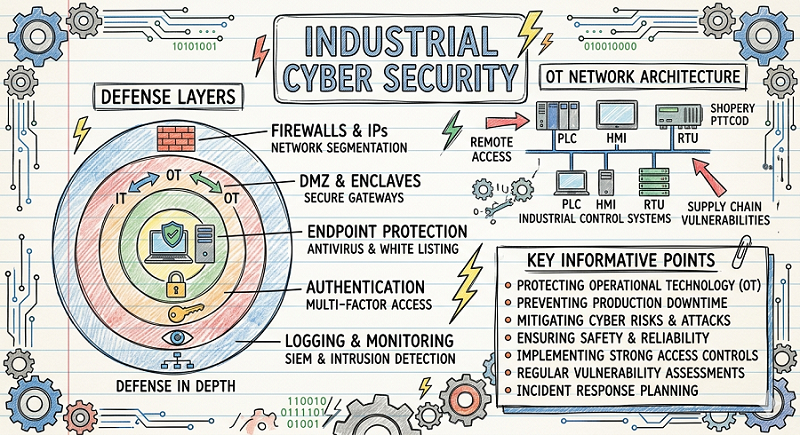
A comprehensive industrial cybersecurity strategy, as promoted by the industry, is a multi-layered approach that combines people, processes, and technology. It begins with gaining visibility. The first step is to create a detailed inventory of all assets on the OT network—the PLCs, HMIs, and other control devices—to understand what needs to be protected. The next layer is network segmentation. This involves creating firewalls and security zones to isolate the critical control network from the less-secure corporate IT network, preventing an attacker from easily moving from one to the other. A crucial component is continuous threat monitoring. This involves deploying specialized security platforms that can passively monitor industrial network traffic, understand the unique industrial protocols (like Modbus or Profinet), and detect anomalous or malicious activity without disrupting the industrial process. Other key components include secure remote access solutions to control how engineers and third-party vendors connect to the OT network, as well as robust incident response planning to ensure a swift and effective reaction in the event of an attack. This defense-in-depth approach is the cornerstone of modern industrial cybersecurity.
The Ecosystem of Players: From OT Giants to Cybersecurity Specialists
The industrial cybersecurity industry is a dynamic ecosystem composed of a diverse range of players. On one side are the major industrial automation giants, such as Siemens, Schneider Electric, ABB, and Rockwell Automation. These companies, who manufacture the core OT equipment, have built out their own cybersecurity practices and service offerings, leveraging their deep understanding of their own systems. On the other side are the traditional IT cybersecurity vendors, like Palo Alto Networks, Fortinet, and Cisco, who are extending their network security and threat detection capabilities to the OT environment. A third and highly influential group consists of the pure-play industrial cybersecurity startups and specialists, such as Dragos, Nozomi Networks, and Claroty. These companies have built their platforms from the ground up with a deep focus on the unique challenges of OT, offering unparalleled visibility and threat detection for industrial networks. This ecosystem is further supported by a community of specialized system integrators and consultants who help asset owners to design and implement their industrial cybersecurity programs, creating a rich and competitive market for these critical solutions.
➤ Latest Market Intelligence from Market Research Future:

 English
 Arabic
 French
 Spanish
 Portuguese
 Deutsch
 Turkish
 Dutch
Dutch
 Italiano
 Romaian
 Portuguese (Brazil)
 Tiếng Việt