
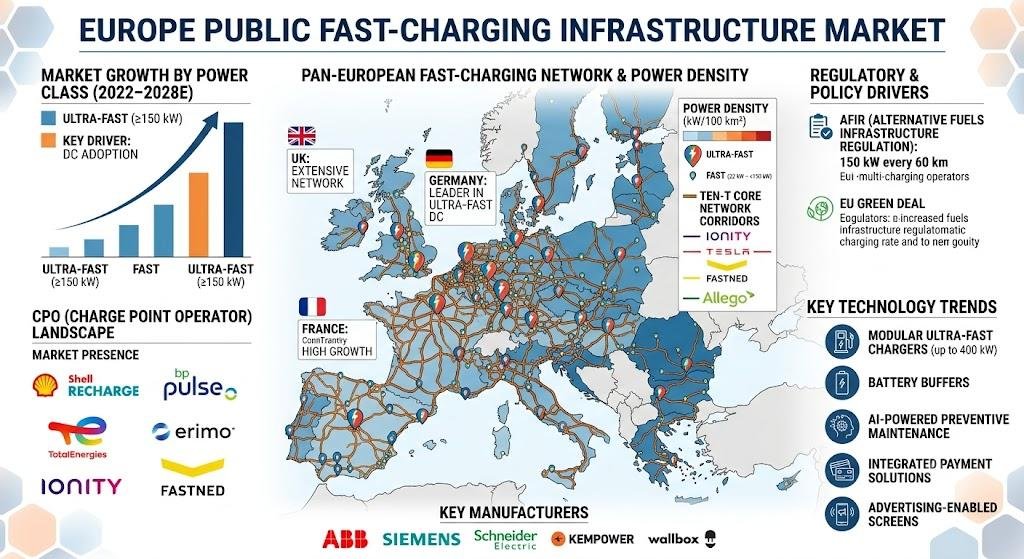
Europe Public Fast-Charging Infrastructure Market: Digitalization Is Transforming Charging Networks
Public electric vehicle charging is evolving from a hardware-focused business into a connected digital service. Modern charging stations increasingly depend on software for authentication, payments, monitoring, pricing, maintenance, and energy management. As networks expand across Europe, digital capabilities can determine whether charging infrastructure remains reliable, scalable, and convenient. This transformation is creating new opportunities within the Europe Public Fast-Charging Infrastructure Market.
A connected charger can continuously communicate operating information to a central platform. Operators can monitor availability, power delivery, faults, and utilization without visiting every site. This visibility helps maintenance teams identify problems quickly and prioritize repairs. Faster intervention can improve uptime, which is critical because drivers are less tolerant of unavailable chargers when public charging becomes an expected mobility service.
Digital payment is equally important. Drivers increasingly expect simple transactions using cards, mobile applications, contactless systems, or roaming services. Complicated registration processes can discourage occasional users, particularly travelers using unfamiliar networks. Transparent pricing displayed before charging can also improve trust. As networks become interconnected, roaming platforms can allow customers to access chargers operated by different companies through a common account or payment relationship.
Software can additionally improve electricity management. When several vehicles charge simultaneously, intelligent systems can allocate available power according to site limits and charging requirements. Dynamic load balancing can reduce unnecessary peaks and help operators avoid oversized electrical infrastructure. More advanced systems can incorporate electricity prices, grid conditions, battery storage, renewable generation, and predicted arrivals to optimize energy use.
Data analytics provides another source of value. Charging sessions can reveal when demand peaks, how long vehicles remain connected, which connectors are most frequently used, and where additional capacity may be required. Operators can compare locations and identify underperforming assets. This information can guide investment decisions and help determine whether a site needs more chargers, higher-power equipment, different pricing, or improved customer amenities.
Artificial intelligence and predictive analytics may strengthen these capabilities. Systems can identify patterns associated with equipment failures and schedule maintenance before a major outage occurs. Demand forecasts can also support staffing, energy procurement, and expansion planning. However, the usefulness of advanced analytics depends on data quality, secure system architecture, and effective integration among hardware and software platforms.
Cybersecurity is becoming a core requirement. Connected charging infrastructure interacts with payment systems, customer accounts, energy networks, and operational technology. Poorly protected systems could create financial, operational, or reputational risks. Operators therefore need appropriate authentication, software updates, access controls, monitoring, and incident response procedures. Cybersecurity investment should be treated as part of infrastructure reliability rather than as an optional digital feature.
Interoperability will shape the next stage of network development. Charging hardware, payment platforms, energy management systems, and roaming services need to exchange information effectively. Open standards can reduce integration barriers and help prevent fragmented customer experiences. As cross-border travel increases, consistent digital access becomes particularly valuable.
Digital platforms can also strengthen customer communication. Automated notifications can tell drivers when charging starts, when a session ends, or when a problem interrupts service. For operators with large networks, consistent communication across thousands of charging points can become an important part of service quality and brand reputation. Better information can also help drivers plan journeys around available charging capacity.
For investors and infrastructure developers, digitalization can influence the lifetime economics of charging assets. Better monitoring can reduce maintenance costs, optimized energy management can improve margins, and demand analytics can increase the productivity of existing equipment. These benefits can become important as competition grows and hardware becomes more standardized.
The future charging network will therefore combine physical infrastructure with software intelligence. Success will depend on reliable equipment, strong connectivity, secure data, flexible energy management, and user-friendly digital services. Stakeholders evaluating investment potential can study the Europe Public Fast-Charging Infrastructure Market Size to assess how expanding charging demand and technology adoption may influence infrastructure requirements through the forecast period.

 English
 Arabic
 Spanish
 Portuguese
 Deutsch
 Turkish
 Dutch
Dutch
 Italiano
 Russian
 Romaian
 Portuguese (Brazil)
 Tiếng Việt