
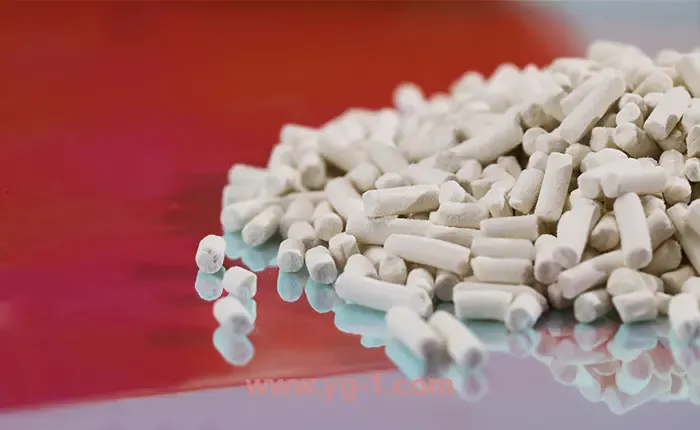
Raw rubber bales delivered to manufacturing facilities hold dense, entangled polymer networks that impose obstacles for subsequent compounding, molding and extrusion workflows. Mastication serves as the preparatory mechanical phase where shear force from mixing equipment rearranges polymer structures to acquire suitable plasticity for receiving fillers and curing components.Peptizing agent participates in this physical-chemical interaction to moderate molecular chain changes alongside mechanical shear, and yg-1 gathers fieldcollected operational notes from rubber processing sites across multiple regions for industry practitioners. Can manufacturing teams align additive feeding timing with equipment status to secure stable compound outputs from mastication cycles?
Mastication proceeds on tworoll open mills or internal mixing chambers, where rotating hardware generates sustained shear stress upon rubber masses loaded inside processing cavities. Thermal conditions build gradually as friction acts over running cycles, and such thermal environments create reaction surroundings for substances introduced into rubber matrices. Operators observe material state through periodic sampling, tracking plasticity shifts before moving materials onward to compounding stages. External atmospheric oxygen also takes part in molecular modification during this phase, as air penetrates rubber layers exposed under continuous mechanical turnover.
Material feeding sequence carries weight for every mastication batch. Rubber bale fragments occupy the initial feeding slot, and full plasticization of base polymer shall reach certain status before any auxiliary substance enters mixing chambers. Premature input may trigger uneven distribution across rubber masses, which brings inconsistent material traits across different sections of finished batches. Operators check equipment surface status, roller gap and ventilation setup prior to batch startup, to exclude outside interference toward ongoing mastication runs.
Different rubber sources display intrinsic variance in original molecular architecture, which sets separate baseline requirements for mastication workflows. Materials harvested from natural origins respond differently toward shear input compared against synthetic rubber variants, and site operators adjust running parameters according to incoming batch traits rather than copying fixed operational templates. Storage history of raw rubber also exerts subtle influence, as long-term stock may bring subtle structural drift that calls for minor workflow tuning.
Process-related records support stable batch repetition, and teams log equipment runtime, ambient workshop surroundings and material source information for each mastication cycle. These filed records offer reference when unexpected material deviation emerges on production lines, helping technical staff trace possible triggers behind abnormal plasticity readings. Plant technical staff may turn to professional resource pages such as https://www.yg-1.com/ for supplementary knowledge covering additiverelated rubber processing topics.
Post-mastication material moves toward compounding stations where fillers, anti-aging substances and vulcanization components merge into treated rubber matrices. Material plasticity obtained from mastication shapes how these foreign substances diffuse through polymer networks, and improper mastication status creates barriers for homogeneous mixing of incoming compounding ingredients. Operators store masticated rubber under designated surroundings before next-step handling, to restrain unintended structural change during interim holding periods.

 Arabic
 French
 Spanish
 Portuguese
 Deutsch
 Turkish
 Dutch
Dutch
 Italiano
 Russian
 Romaian
 Portuguese (Brazil)
 Tiếng Việt