
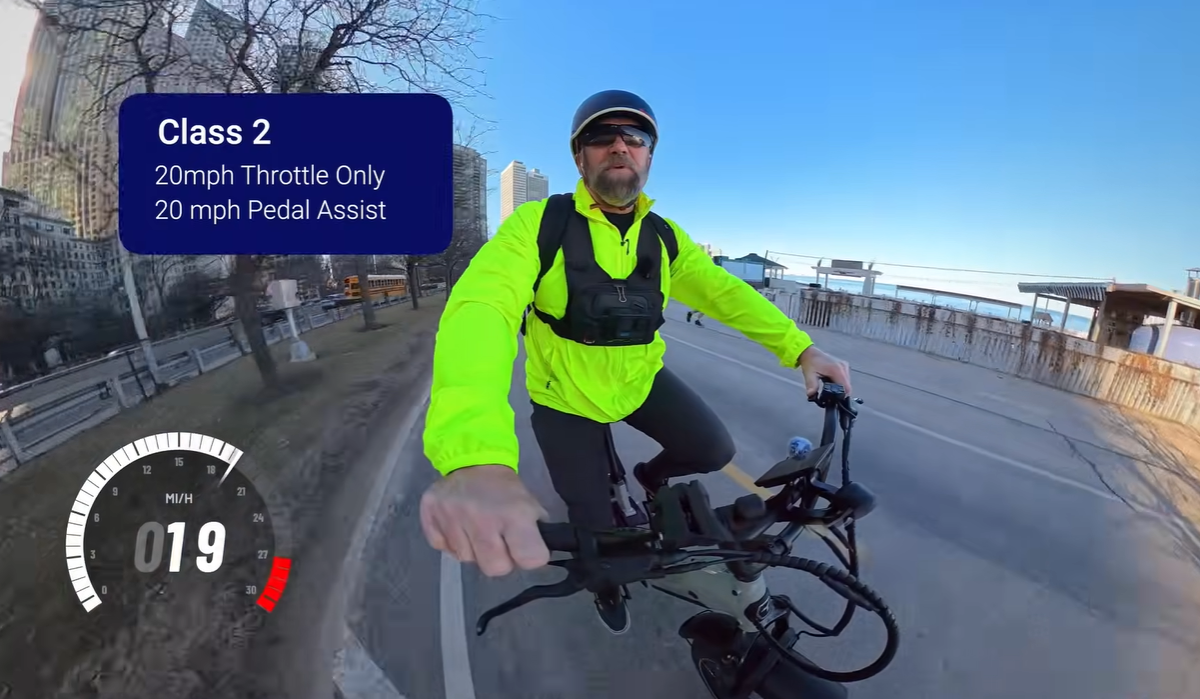
If you own a Class 2 eBike and want to take it onto a mountain bike trail, the answer is: sometimes, but definitely not everywhere.
Class 2 eBikes generally have pedal assist plus a throttle, with motor assistance limited to 20 mph. That throttle is important when it comes to trail access. Many trail systems that allow regular mountain bikes—or even Class 1 pedal-assist eBikes—do not automatically allow Class 2 eBikes.
So before taking a bike such as a Himiway D5, D5 Pro, D7, D7 Pro, or D5 2.0 onto a trail, it is worth checking the rules for that specific location.
Why Class 2 eBike Rules Are Different
The main issue is the throttle.
A Class 1 eBike provides motor assistance only while you are pedaling. A Class 2 eBike can also use its motor without pedaling, usually through a thumb or twist throttle.
Because of this difference, some land managers treat Class 2 eBikes more like motorized vehicles. This is especially common on natural-surface singletrack trails.
The important point is that the 20 mph limit does not automatically make a Class 2 eBike legal on every bicycle trail. The trail designation and local regulations matter more than the bike's maximum assisted speed.
Where Can You Usually Ride a Class 2 eBike?
Rules vary significantly across the United States, but there are some useful general patterns.
US Forest Service Land
On National Forest System lands, you should not assume that an eBike can use a trail simply because conventional mountain bikes are allowed.
US Forest Service policy generally treats eBikes as motor vehicles for travel-management purposes. In practice, eBikes are commonly allowed on roads and trails designated for motorized use, while non-motorized trails are generally off-limits unless specifically designated otherwise.
For a Class 2 rider, Forest Service roads and designated motorized trails may therefore provide more riding opportunities than traditional non-motorized singletrack.
Always check the Motor Vehicle Use Map and current information from the individual National Forest before riding.
BLM Land
Bureau of Land Management rules also depend on the designation of the individual trail or area.
Class 2 eBikes can generally use routes where motorized vehicles are permitted. Some BLM-managed areas may also allow certain classes of eBikes on additional trails following local land-management decisions.
This means two BLM trail systems can have different rules even if they are relatively close to each other.
State Parks
State park regulations are much less consistent.
Some states provide fairly broad access to Class 1 and Class 2 eBikes on trails where bicycles are permitted. Others allow only Class 1 eBikes on natural-surface mountain bike trails.
There may even be different rules within the same state depending on the park.
City and County Trails
Local rules can be particularly restrictive.
A city or county might allow Class 1 eBikes on mountain bike trails while limiting Class 2 bikes to paved or improved multi-use paths. Another jurisdiction may permit Class 2 bikes on selected trails.
Therefore, don't assume that a rule from a nearby trail applies to the trail you are planning to ride.
Why Are Throttle eBikes Sometimes Restricted?
Land managers have several concerns when deciding whether Class 2 eBikes should be allowed.
One is speed differences between trail users. A throttle makes it possible to accelerate without pedaling, which can potentially create conflicts on narrow trails shared with hikers, horses, and conventional mountain bikes.
Trail sustainability is another consideration. Land managers may evaluate traffic volume, trail design, soil conditions, speed, and other factors when deciding which types of vehicles should have access.
That doesn't mean every Class 2 rider damages trails. Riding behavior matters enormously. A responsible rider who slows around hikers, avoids skidding, stays off muddy trails, and yields appropriately can have a very different impact from an aggressive rider.
What About Himiway Class 2-Capable eBikes?
This is particularly relevant if you're considering trail riding with a Himiway eBike.
Models in the Himiway lineup, such as the D5, D5 Pro, D7, D7 Pro, D5 2.0 and related configurations, can offer features that are useful when riding rough roads and appropriate recreational routes. Depending on the specific model, these can include fat tires, suspension, powerful motors, and long-range batteries.
For example, the Himiway D5 2.0 is designed with full suspension, while the D5 2.0 20" combines full suspension with smaller 20-inch fat tires and a lower center of gravity.
From a rider's perspective, these features can make uneven surfaces, gravel roads, bumps, and rough recreational routes much more comfortable. The smaller-wheel D5 2.0 20" can also feel easier to maneuver at lower speeds, particularly for riders who prefer a more compact bike.
But a bike's off-road capability and its legal trail access are two completely different things.
A Himiway may be physically capable of handling a particular trail, but that does not mean the trail manager permits that class of eBike there.
A Practical Example
Imagine you have a Himiway D5-series bike and are planning a weekend ride.
You find three possible routes:
- A Forest Service road open to motorized vehicles
- A designated OHV trail
- A narrow non-motorized mountain bike singletrack
The first two may permit your Class 2 eBike, depending on their specific designations.
The third could prohibit it even though conventional mountain bikes are allowed.
This is why searching for "mountain bike trail" isn't enough. You need to know both the trail designation and the eBike class permitted.
Can You Just Disable the Throttle?
This is a common question.
Some Class 2 eBikes allow the throttle to be disabled or removed, which may make the bike functionally similar to a Class 1 eBike.
However, do not assume this automatically changes the bike's legal classification for trail access.
Rules differ between jurisdictions. Some land managers may consider how the bike is configured while it is being operated, while others may use its original classification or equipment.
If a trail says "Class 1 only," check with the park, trail manager, or ranger before using a modified Class 2 bike there.
How I Would Check a Trail Before Riding
It only takes a few minutes and can prevent an unpleasant situation later.
- Find out who manages the land. Determine whether it is USFS, BLM, state, county, city, or private property.
- Open the official trail information. Don't rely solely on Google Maps or a cycling app.
- Look specifically for eBike rules. "Bicycles allowed" does not necessarily mean Class 2 eBikes are allowed.
- Check the permitted classes. Look for Class 1, Class 2, Class 3, motorized, or OHV designations.
- Check individual trail restrictions. Rules can differ within the same park.
- Ask the land manager if you're unsure. This is especially worthwhile when the website simply says "eBikes permitted" without identifying the classes.
I would also check for temporary closures. Wildfire risk, trail maintenance, wildlife protection, wet conditions, or seasonal restrictions can close an otherwise legal trail.
Trail Etiquette Matters Too
Even where Class 2 eBikes are legal, good trail behavior is important.
Slow down when approaching hikers and other cyclists. Give horses plenty of room and follow the local right-of-way rules. Avoid spinning the rear tire when climbing, don't skid unnecessarily on descents, and avoid soft or muddy trails where your tires can leave deep ruts.
With a powerful fat-tire eBike such as a Himiway D5-series model, you often have plenty of motor assistance available. You don't need to use all of it.
On shared trails, lower assist levels can make the ride smoother and more predictable. Riders may also find that moderate assistance provides better battery efficiency and more natural control on technical sections.

 Arabic
 French
 Spanish
 Portuguese
 Deutsch
 Turkish
 Dutch
Dutch
 Italiano
 Russian
 Romaian
 Portuguese (Brazil)
 Tiếng Việt