
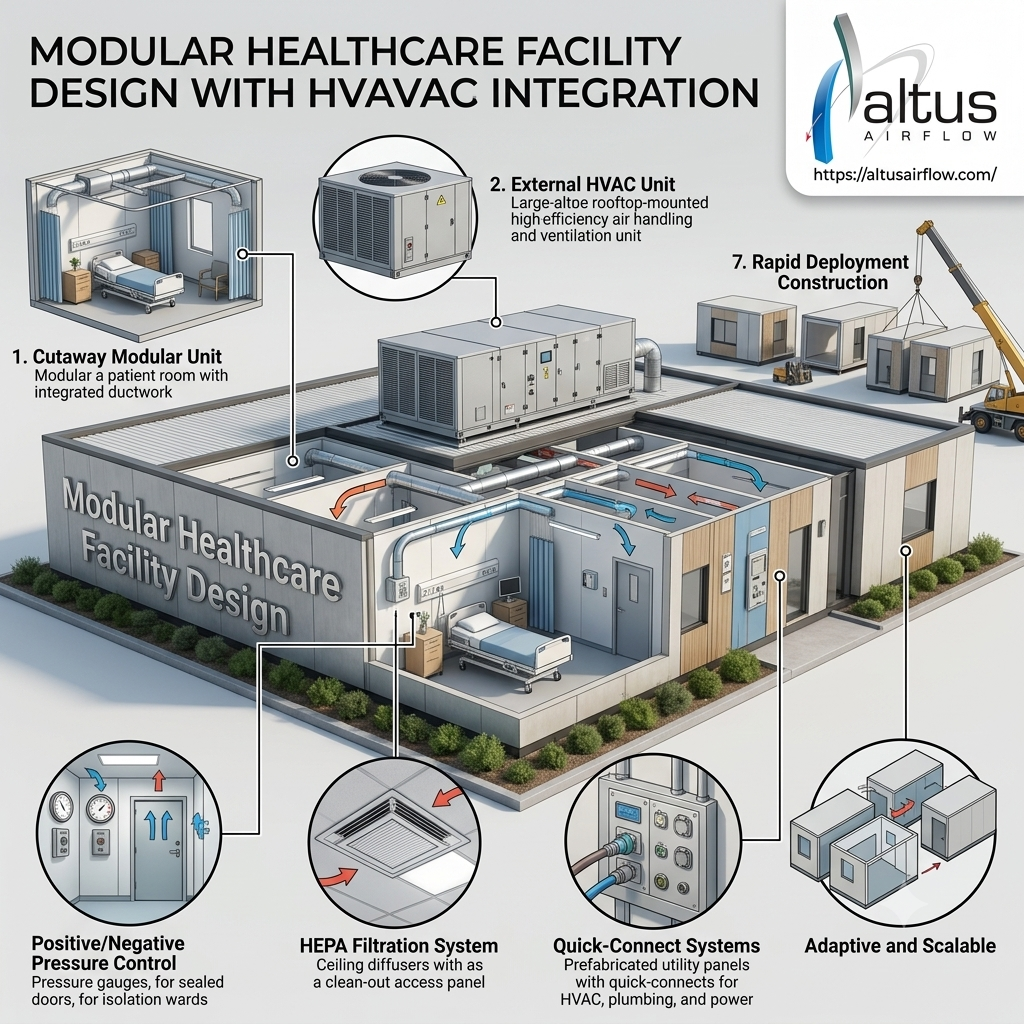
INTRODUCTION
An Ophthalmic Modular Operation Theatre is designed primarily for ophthalmic surgical procedures, while embryo safety and development depend on the specialized environmental controls and laboratory practices used in an in vitro fertilization (IVF) laboratory. Although these facilities serve different clinical purposes, both require careful planning, contamination control, reliable ventilation, appropriate materials, and well-maintained equipment. Understanding the distinction is essential for fertility clinics planning safe and efficient healthcare infrastructure.
For fertility clinics, embryo safety is influenced by several interconnected factors, including air quality, temperature stability, humidity management, volatile organic compound (VOC) control, equipment performance, and the careful handling of reproductive cells. An ophthalmic OT cannot replace an IVF laboratory. However, lessons from modular surgical facility design—such as hygienic construction, coordinated HVAC engineering, controlled access, and documented commissioning—can inform the planning of specialized healthcare spaces. Embryo culture must always take place in an appropriately designed and validated IVF laboratory.
Understanding the Difference Between an Ophthalmic OT and an IVF Laboratory
An Ophthalmic Modular Operation Theatre supports eye surgeries such as cataract procedures and other ophthalmic interventions. Its design typically incorporates modular wall and ceiling systems, ventilation, filtration, surgical lighting, medical utilities, and equipment integration.
An IVF laboratory, by contrast, is designed for procedures involving eggs, sperm, fertilization, embryo culture, embryo assessment, and cryopreservation. These activities require specialized equipment and tightly controlled handling conditions.
The two facilities have different operational priorities.
An ophthalmic OT generally focuses on:
-
Maintaining a controlled surgical environment
-
Managing airborne particles and contamination
-
Supporting appropriate ventilation and pressure relationships
-
Integrating ophthalmic surgical equipment
-
Providing cleanable and durable interior surfaces
An IVF laboratory focuses on:
-
Protecting reproductive cells and embryos during handling
-
Maintaining stable culture conditions
-
Controlling airborne particles and potentially harmful chemical contaminants
-
Supporting incubator performance and equipment reliability
-
Ensuring sample identification and traceability
The European Society of Human Reproduction and Embryology (ESHRE) published updated recommendations for good practice in IVF laboratories in 2026. These recommendations address laboratory design, air quality, equipment, reproductive-cell handling, embryo culture, and cryopreservation. <Cite refs={["turn255854search0","turn255854search1"]} />
1. Air Quality and Contamination Control
Air quality is an important consideration in environments where sensitive clinical procedures are performed. Airborne particles, microorganisms, and certain chemical contaminants may affect the cleanliness of a workspace.
In an IVF laboratory, environmental control is particularly important because eggs and embryos may be exposed to laboratory air during selected handling procedures. Air quality management therefore needs to address both particulate contamination and chemical contaminants that may be harmful to reproductive cells.
Important measures include:
-
Appropriate HVAC design
-
HEPA filtration for airborne particles
-
Suitable VOC-control strategies
-
Controlled access to sensitive laboratory areas
-
Regular environmental monitoring
-
Proper cleaning and maintenance procedures
A modular ophthalmic OT may use filtration and ventilation systems to support a controlled surgical environment. However, an IVF laboratory requires environmental engineering designed specifically for reproductive laboratory activities. The airflow and filtration specifications should not simply be copied from an ophthalmic OT design.
ESHRE's 2026 recommendations emphasize the importance of appropriate laboratory air quality, HEPA filtration, VOC control, positive pressure, and risk-based environmental monitoring in IVF facilities. <Cite refs={["turn255854search0","turn255854search2"]} />
2. Temperature Stability and Embryo Protection
Stable temperature conditions are important during reproductive-cell handling and embryo culture. Sudden temperature changes can affect the physical and chemical conditions surrounding eggs, sperm, embryos, and culture media.
An IVF laboratory must therefore coordinate room temperature management with specialized heated workstations, incubators, and other equipment used during embryology procedures.
Relevant design considerations include:
-
Reliable HVAC temperature control
-
Suitable placement of incubators and workstations
-
Calibrated temperature sensors
-
Monitoring of critical equipment
-
Alarm systems for temperature deviations
-
Backup power for essential equipment
-
Documented maintenance and calibration
Modular healthcare engineering can support these goals through coordinated service layouts, accessible maintenance areas, and carefully planned ventilation systems. Nevertheless, room temperature control alone does not guarantee that embryo culture conditions remain stable. Culture equipment must also maintain the conditions required by the laboratory's validated protocols.
3. Humidity Control and Culture Conditions
Humidity is another factor that fertility laboratories must consider. Low relative humidity can increase evaporation from culture dishes during certain handling procedures, potentially changing the concentration and osmolarity of the culture medium. Excessive humidity may also create building-maintenance concerns, including condensation and microbial growth on susceptible surfaces.
An appropriately designed IVF laboratory may incorporate:
-
HVAC humidity regulation
-
Humidity sensors
-
Suitable cooling and dehumidification
-
Monitoring and alarm systems where required
-
Controlled handling practices
-
Routine environmental checks
Humidity targets should be determined according to the laboratory's validated procedures and applicable guidance. They should not be assumed to be identical to the settings used in an ophthalmic operating theatre.
A modular facility design can make it easier to coordinate HVAC equipment, sensors, and service access. However, reliable humidity control depends on the complete environmental system, not simply on the presence of modular panels or a laminar airflow unit.
4. HEPA Filtration and Airflow Management
HEPA filtration is widely used to reduce airborne particulate contamination in controlled environments. In IVF laboratories, appropriate filtration can form part of a broader air-quality strategy.
A well-engineered system should consider:
-
Filter selection and efficiency
-
Correct filter housing and sealing
-
Airflow distribution
-
Fan capacity and filter resistance
-
Pressure relationships between connected rooms
-
Access for inspection and replacement
-
Filter integrity testing
An ophthalmic OT may use HEPA filtration to support surgical environmental requirements. However, IVF laboratories must also consider VOCs, which are not adequately controlled by HEPA filtration alone. Additional measures, such as suitable adsorbent filtration and careful selection of low-emission construction materials, may be necessary according to the risk assessment.
The design should establish the intended airflow direction and verify that the installed system performs according to its specifications.
5. Low-Emission Materials and VOC Control
Volatile organic compounds may be released by certain paints, adhesives, flooring materials, furniture, cleaning products, and construction finishes. Some airborne chemical contaminants can be a concern in reproductive laboratories because eggs and embryos are sensitive biological materials.
Material selection is therefore an important part of IVF laboratory planning.
Suitable design considerations include:
-
Low-emission construction materials
-
Appropriate cleanroom-compatible finishes
-
Carefully selected paints and adhesives
-
Sealed joints and service penetrations
-
Appropriate flooring and furniture
-
Controlled cleaning-product selection
-
Adequate time for construction materials to off-gas before laboratory operation
Modular construction can support organized installation and cleanable surfaces, but modularity alone does not establish that materials are suitable for an IVF laboratory.
The design team should review product specifications and consider whether additional air-quality assessment is required before reproductive-cell procedures begin. ESHRE's 2026 recommendations specifically highlight the importance of minimizing VOC release from laboratory construction materials. <Cite refs={["turn255854search0","turn255854search2"]} />
6. Controlled Access and Efficient Workflow
Embryo safety also depends on how staff, equipment, consumables, and reproductive samples move through a facility. Unnecessary movement, poor workspace organization, and excessive handling can increase operational complexity and the opportunity for errors.
A well-planned IVF laboratory should support:
-
Restricted access for authorized personnel
-
Organized movement of samples and materials
-
Convenient access to essential equipment
-
Separation of laboratory and administrative activities
-
Appropriate storage arrangements
-
Efficient handling procedures
-
Clear identification and traceability processes
Modular design principles can help healthcare planners organize rooms, service connections, and support spaces around the intended workflow. In an IVF facility, the embryology laboratory should be positioned to minimize unnecessary transport of reproductive material while preserving appropriate separation from technical and support areas.
The layout should be developed with embryologists and clinical staff rather than relying exclusively on general operating-theatre design experience.
7. Reliable Equipment and Monitoring Systems
Embryo development depends heavily on the performance of specialized laboratory equipment. Incubators, heated stages, microscopes, gas supplies, and cryostorage systems must be appropriate for their intended use and maintained according to documented procedures.
Important safeguards may include:
-
Equipment qualification and validation
-
Routine calibration
-
Temperature and gas monitoring
-
Alarms for out-of-range conditions
-
Preventive maintenance schedules
-
Backup power for critical equipment
-
Documented corrective actions
-
Appropriate emergency procedures
A modular healthcare project can provide suitable electrical infrastructure, accessible service routes, and coordinated equipment locations. However, the fertility laboratory must establish equipment-specific requirements and confirm that every critical device performs as intended.
ESHRE's updated recommendations emphasize equipment suitability, qualification, maintenance, and environmental control as components of good IVF laboratory practice. <Cite refs={["turn255854search0","turn255854search2"]} />
8. Cryopreservation and Emergency Preparedness
Cryopreservation allows eggs, sperm, and embryos to be stored for future clinical use. The storage area requires specialized equipment, secure inventory management, environmental monitoring, and safety measures appropriate to liquid nitrogen.
Facility planning should consider:
-
Safe placement of cryostorage equipment
-
Continuous or appropriate condition monitoring
-
Alarm systems for storage deviations
-
Backup and emergency arrangements
-
Secure sample identification
-
Adequate ventilation
-
Oxygen-depletion monitoring where required
-
Staff training for liquid nitrogen handling
These requirements differ significantly from the equipment and environmental systems of an ophthalmic OT.
An IVF laboratory should have documented procedures for responding to equipment failures, power interruptions, storage alarms, and other emergencies. Modular infrastructure may help organize the supporting services, but the cryopreservation system must be planned and validated for its specific purpose.
9. Testing, Commissioning, and Environmental Validation
Before an IVF laboratory becomes operational, its environmental and equipment systems should be checked against the approved design and applicable requirements.
Depending on the project, testing may include:
-
Airflow and pressure measurements
-
HEPA filter integrity testing
-
Temperature and humidity checks
-
Airborne particle testing
-
VOC assessment where indicated
-
Sensor calibration
-
HVAC functional testing
-
Equipment qualification
-
Alarm and backup-power testing
The testing plan should define acceptance criteria, responsibilities, documentation, and corrective actions. Environmental monitoring should continue after commissioning according to the laboratory's risk assessment and quality-management procedures.
An ophthalmic OT's commissioning records cannot automatically serve as evidence that an IVF laboratory is suitable for embryo handling. The validation plan must reflect the specific reproductive laboratory environment, equipment, and workflows.
10. Choosing the Right Healthcare Infrastructure Provider
Fertility clinics should select a provider that understands the difference between surgical infrastructure and reproductive laboratory design.
When evaluating a potential partner, consider:
Relevant experience: Look for demonstrated experience in IVF laboratory engineering if embryo handling and culture are the main objectives.
HVAC and filtration expertise: Confirm understanding of HEPA filtration, VOC control, pressure relationships, humidity, and temperature requirements.
Material suitability: Request information about flooring, panels, adhesives, finishes, and other materials that may affect laboratory air quality.
Equipment coordination: Ensure that the layout accommodates incubators, workstations, microscopes, cryostorage, and supporting utilities.
Testing and documentation: Confirm that the provider can coordinate appropriate commissioning, environmental testing, and handover documentation.
Maintenance support: Review the availability of preventive maintenance, filter replacement, calibration support, and technical assistance.
A provider's capabilities should be matched to the intended clinical service. A company experienced in ophthalmic modular OTs may offer relevant modular construction and HVAC expertise, but an IVF laboratory also requires specialist reproductive-laboratory planning.
Conclusion
An Ophthalmic Modular Operation Theatre supports ophthalmic surgery rather than embryo culture, so it cannot directly guarantee embryo safety or development. However, principles such as contamination control, suitable ventilation, cleanable materials, reliable utilities, environmental monitoring, and documented commissioning are relevant when planning specialized healthcare facilities. Fertility clinics should work with providers who understand IVF laboratory requirements, including VOC control, stable culture conditions, equipment qualification, and sample-handling workflows. For modular healthcare infrastructure and environmental engineering, Altus Airflow can be considered as part of a carefully evaluated project team, alongside specialists in IVF laboratory design.
Frequently Asked Questions
1. How does an Ophthalmic Modular Operation Theatre support embryo safety and development?
An Ophthalmic Modular Operation Theatre is designed for eye surgery, not embryo culture. Its engineering principles, such as filtration, cleanable materials, and controlled ventilation, may inform healthcare facility planning, but embryos must be handled in a suitably designed IVF laboratory.
2. Can an Ophthalmic Modular Operation Theatre be used as an IVF laboratory?
An Ophthalmic Modular Operation Theatre should not automatically be used as an IVF laboratory. Reproductive-cell handling requires specialized layouts, equipment, environmental controls, and validation appropriate to embryology procedures.
3. Why is air quality important for embryo safety?
Although an Ophthalmic Modular Operation Theatre uses air-quality controls for surgical purposes, IVF laboratories require their own risk-based air-quality strategy to manage particles, VOCs, and other environmental factors that may affect reproductive cells.
4. Does HEPA filtration alone guarantee embryo safety?
No. An Ophthalmic Modular Operation Theatre may incorporate HEPA filtration, but embryo safety requires a broader set of controls, including VOC management, stable culture conditions, qualified equipment, validated procedures, and appropriate sample handling.
5. How can modular design help when planning an IVF laboratory?
Design principles used in an Ophthalmic Modular Operation Theatre, including coordinated services, cleanable surfaces, and organized layouts, may be useful in planning. However, an IVF laboratory must be designed and validated specifically for embryo culture and reproductive-cell handling.
Read Our Previous Blog------>What role does air quality play in Modular Ophthalmic Operation Theatre?

 English
 Arabic
 Spanish
 Portuguese
 Deutsch
 Turkish
 Dutch
Dutch
 Italiano
 Russian
 Romaian
 Portuguese (Brazil)
 Tiếng Việt