
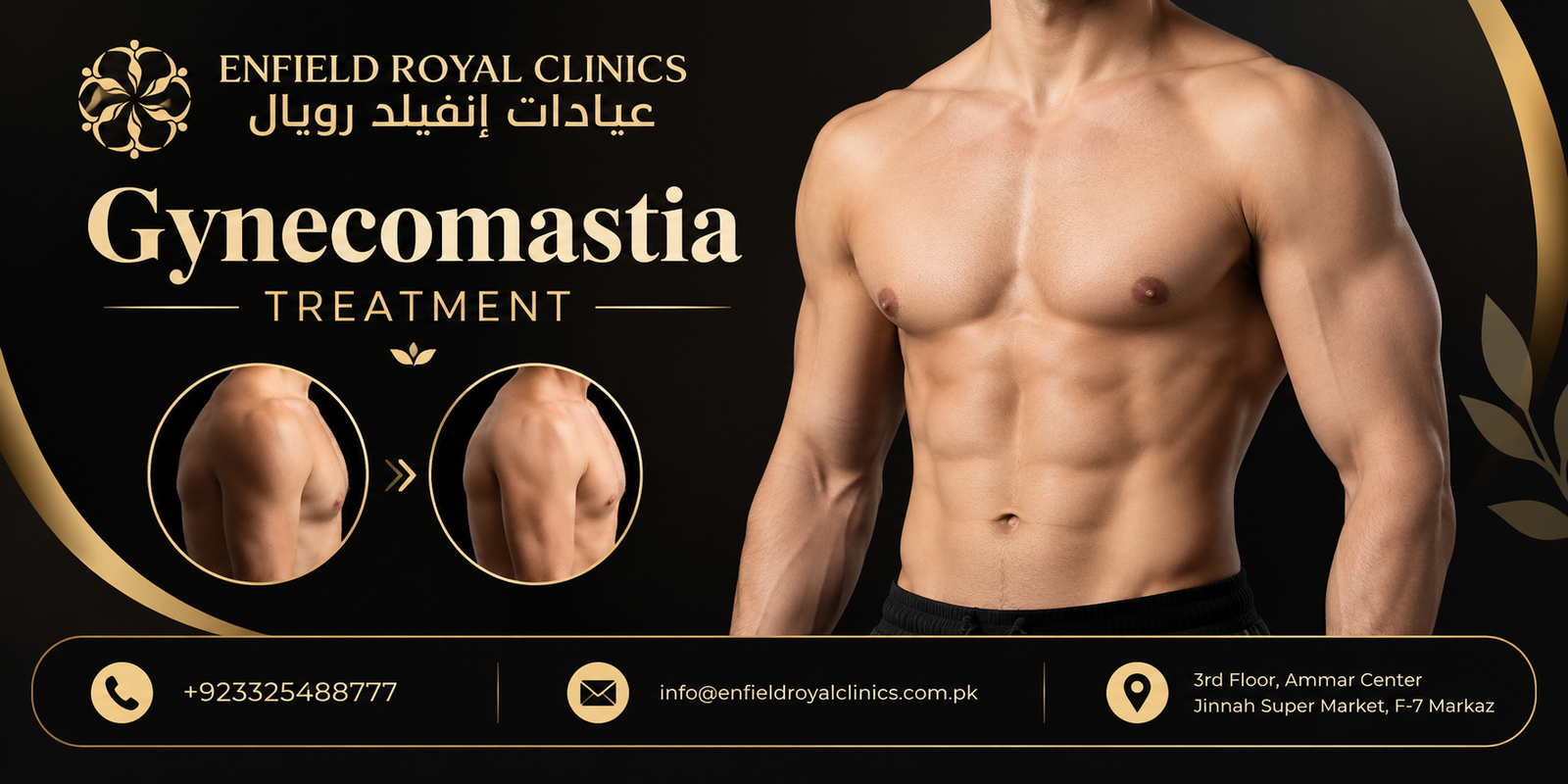
A balanced chest can contribute to a more proportionate and natural-looking upper body. When gynecomastia causes excess breast tissue, fat, or uneven enlargement, the chest may appear rounded, prominent, or different on one side. Gynecomastia treatment focuses on addressing these changes and creating a smoother, flatter, and more balanced chest contour.
For men considering Gynecomastia in Islamabad, treatment planning usually depends on the amount and type of excess tissue, skin elasticity, chest shape, and individual goals. The approach is not simply about removing tissue. It is about improving overall chest proportions while maintaining a natural appearance.
How Does Gynecomastia Affect Chest Balance?
Gynecomastia can change the natural proportions of the male chest. Excess glandular tissue may create a firm area beneath the nipple, while excess fat can contribute to a softer or fuller appearance. Some men may experience both types of tissue at the same time.
Chest imbalance can also occur when enlargement is more noticeable on one side than the other. Even a relatively small difference between the two sides may become visible through fitted shirts or when the upper body is viewed from different angles.
Because the underlying causes can vary, treatment begins with understanding the chest structure. This helps determine which areas need to be reduced and how the remaining tissue should be shaped.
How Can Treatment Reduce Excess Chest Tissue?
One of the main ways gynecomastia treatment restores balance is by reducing unwanted tissue. When excess fat contributes to chest fullness, liposuction may be used to remove localized fat and create a flatter contour.
Firm glandular tissue may require a different approach because it cannot always be adequately reduced through fat removal alone. Direct removal of excess glandular tissue may therefore be considered when appropriate.
In cases where both fat and glandular tissue are present, a combination of techniques may help achieve a more even result. The objective is to reduce unnecessary fullness while preserving enough natural tissue to avoid an overly hollow or unnatural appearance.
Can Gynecomastia Treatment Improve Chest Symmetry?
Yes, improving symmetry can be an important part of treatment. Naturally, the two sides of the human body are rarely perfectly identical, but significant differences in chest size or shape can sometimes be reduced.
During treatment planning, the shape and volume of each side can be assessed separately. Areas with greater fullness may require more tissue reduction, while the other side may need a different degree of contouring.
Improving symmetry can make the chest appear more proportionate from the front and side. The goal is generally not mathematical perfection but a more harmonious appearance between the two sides.
What Role Does Skin Elasticity Play in Chest Balance?
Skin elasticity can influence how the chest looks after excess tissue has been removed. Younger or more elastic skin may contract more effectively around the newly reduced contour. Skin with less elasticity may not tighten as readily.
The amount of excess tissue and the degree of skin looseness also matter. If a large amount of tissue has created stretched skin, treatment planning may need to account for how that skin is expected to respond after reduction.
This is why the same treatment approach may not be suitable for every man. A personalized assessment can help determine how much tissue should be reduced while considering the expected response of the skin.
How Can Treatment Create a More Natural Chest Contour?
Restoring balance involves more than making the chest smaller. The contour should transition naturally into the surrounding chest, shoulder, and upper abdominal areas.
Careful contouring can help reduce noticeable fullness around the nipple and other areas affected by excess tissue. The remaining chest structure can then appear flatter and more evenly shaped.
A natural-looking result also depends on avoiding excessive tissue removal. Removing too much can create depressions or irregularities. Appropriate planning focuses on controlled reduction and smooth transitions rather than simply removing as much tissue as possible.
What Can Men Expect During Recovery?
Swelling and bruising are common after gynecomastia treatment and can temporarily affect chest symmetry. This means the chest may not look balanced immediately after the procedure.
As healing progresses, swelling gradually decreases and the contours become easier to see. A compression garment may be recommended to support the healing tissues and help manage postoperative swelling.
Light movement may be encouraged during recovery, while strenuous exercise and heavy lifting are generally restricted until healing has progressed. Following postoperative instructions can help support a smoother recovery.
The final chest shape usually develops gradually rather than appearing immediately. Patience is important while swelling settles and the tissues adjust.
How Can Balanced Results Be Maintained Long Term?
Long-term results can be supported by maintaining a stable and healthy body weight. Significant weight gain can increase chest fat and may affect the appearance of the treated area.
Changes in hormones, certain medications, and some underlying health conditions can also contribute to renewed breast enlargement. Persistent or new chest enlargement after treatment should therefore be evaluated rather than automatically assumed to be caused by weight gain.
A healthy lifestyle, regular physical activity, and appropriate medical evaluation when changes occur can help support the appearance achieved through treatment.
FAQs
1. Can gynecomastia treatment make both sides of the chest more symmetrical?
Treatment can reduce differences in chest fullness and shape. The approach is planned according to the characteristics of each side to create a more balanced appearance.
2. Does gynecomastia treatment remove all chest tissue?
No. The objective is generally to reduce excess fat and/or glandular tissue while preserving an appropriate amount of natural tissue for a smooth and natural contour.
3. How long does it take to see a balanced chest after treatment?
Some improvement may be visible soon after treatment, but swelling can temporarily affect the appearance. The chest usually becomes more defined as healing progresses over the following weeks and months.
4. Can gynecomastia return after treatment?
Long-lasting improvement is possible, but significant weight changes, hormonal changes, certain medications, or underlying health conditions may contribute to renewed chest enlargement in some cases.
For more information visit Enfield royal clinic in islamabad

 English
 Arabic
 French
 Spanish
 Portuguese
 Deutsch
 Turkish
 Dutch
Dutch
 Russian
 Romaian
 Portuguese (Brazil)
 Tiếng Việt