
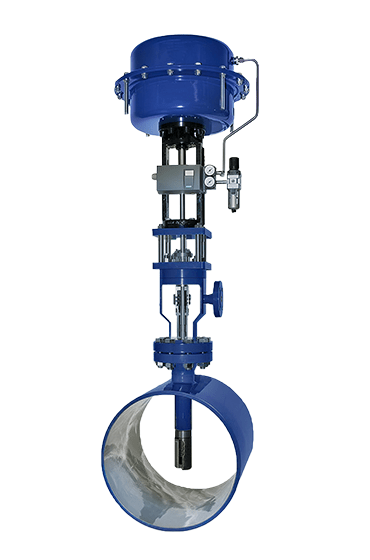
How to Size and Select a Steam Desuperheater Valve
An undersized or poorly specified desuperheater leads to unstable temperature control, wet steam and early wear. A correctly sized unit, on the other hand, holds outlet temperature steady with minimal maintenance. Good sizing starts with good data.
Step 1: Collect Accurate Process Data
Gather the following before requesting a quotation:
- Steam flow: minimum, normal and maximum
- Inlet steam: pressure and temperature
- Required outlet temperature and allowable tolerance
- Outlet steam pressure
- Spray water: temperature, pressure and quality
- Pipe size and schedule at the injection point
- Straight pipe length available downstream
Missing or rounded data is the most common cause of poor selection. Always state the full flow range, including start-up and low-load conditions.
Step 2: Calculate Spray Water Demand
Water demand comes from an energy balance. The heat removed from the superheated steam equals the heat absorbed by the water as it warms and evaporates:
Water flow = Steam flow × (h inlet − h outlet) ÷ (h outlet − h water)
Here, h is specific enthalpy, taken from steam tables. A larger temperature drop needs more water. Because the water flow is small compared with steam flow, the water control valve must have fine resolution and good rangeability.
Step 3: Confirm Spray Water Pressure
Water must be injected against steam pressure, so supply pressure must exceed steam pressure with a comfortable margin, typically several bar. That margin gives the pressure drop across the nozzle that produces fine droplets. Weak water pressure at low flow is a frequent cause of poor atomisation and control problems.
Step 4: Set a Safe Approach to Saturation
The outlet temperature should stay above saturation temperature, with a margin. If it is set too close, liquid droplets may survive, causing erosion, thermal shock and unstable readings. A margin of roughly 10–15 °C above saturation is a common minimum, though the right figure depends on the design and the evaporation length available. Always confirm it with the manufacturer.
Step 5: Check Turndown and Evaporation Length
Define the true operating range. If steam flow may fall to a small fraction of maximum, choose a variable-orifice or steam-atomising design. Then check that the available straight pipe downstream is enough for complete evaporation. Low velocity, high superheat reduction and coarse droplets all lengthen the distance needed.
Step 6: Select Materials
Match materials to steam temperature and pressure:
- Carbon steel (A216 WCB, A105): moderate temperature duty
- Chrome-moly (WC6, WC9, F11, F22): higher temperature steam
- Stainless steel and hardened trim: nozzles and wear parts exposed to erosion
Step 7: Verify Standards and Testing
Confirm pressure-temperature ratings to ASME B16.34 and flange dimensions to ASME B16.5. Control valve capacity is calculated to ISA/IEC 60534, and seat leakage is often classified to ANSI/FCI 70-2. Hydrostatic and seat tests to API 598 are standard requirements for the valve components.
Common Sizing Mistakes
- Sizing only for the maximum flow and ignoring low-load operation
- Setting outlet temperature too close to saturation
- Using untreated or poor-quality spray water
- Overlooking pressure drop and downstream pipe length
- Ignoring actuator response time
Selection Checklist
- Full flow range defined
- Water demand calculated
- Water pressure margin confirmed
- Saturation margin confirmed
- Turndown matched to design type
- Materials and standards verified
- Actuation and control signal specified
Conclusion
Accurate data leads to accurate sizing. Take the time to define the real operating range, and ask your supplier to confirm evaporation length and turndown in writing.
Freture Techno supports customers with application-based selection of steam desuperheater valves for critical conditioning duties in oil & gas, petrochemical, power and chemical plants. Send us your process data for a technical recommendation.

 Arabic
 French
 Spanish
 Portuguese
 Deutsch
 Turkish
 Dutch
Dutch
 Italiano
 Russian
 Romaian
 Portuguese (Brazil)
 Tiếng Việt