
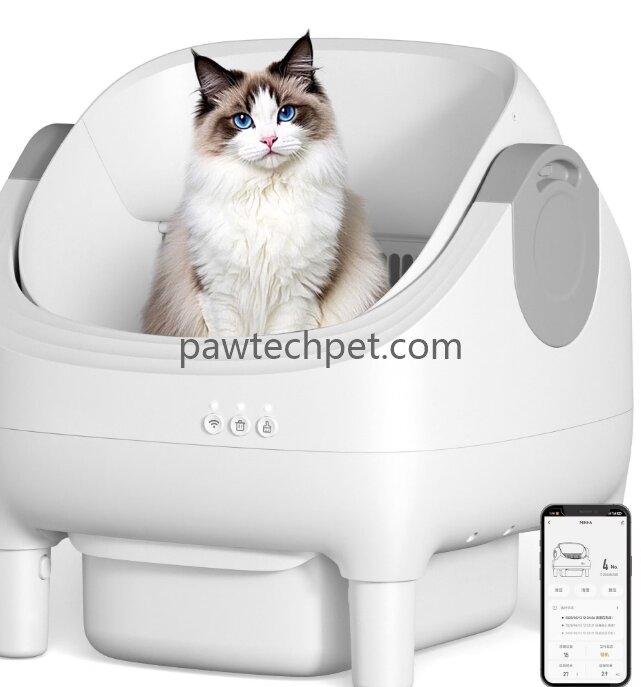
Automation is becoming an important part of modern household pet care as owners look for practical ways to manage repetitive maintenance tasks. Cat Litter Box Automatic Cleaning systems combine mechanical movement, sensors, waste collection, and electronic control to support more convenient litter management. Effective product development requires attention to the interaction between technology, animal behavior, household maintenance, and manufacturing quality.
The basic operating concept involves separating used litter and waste from the remaining litter through a controlled mechanical process. Depending on the product architecture, the system may use rotating, screening, lifting, or other movement mechanisms. The design needs to provide a predictable path for waste collection while maintaining an appropriate environment for the cat during normal use.
Sensor integration is an important part of automation. Sensors may detect whether the litter area has been occupied, whether a cleaning cycle is appropriate, or whether a particular operating condition has been reached. The control system can then process this information and activate the relevant mechanism according to programmed logic. Sensor placement and control settings should be evaluated together during product development.
Mechanical structure also affects the overall performance of an automated litter system. Moving components need sufficient clearance to operate without unnecessary interference. Gears, shafts, screens, rotating parts, and collection structures should be designed according to their intended movement. Prototype testing can help engineers identify friction, alignment, or structural issues before products enter larger-scale production.
The waste collection area should be designed for practical daily use. Once waste has been separated, it needs to move into a designated container that can be removed when disposal is required. The container should provide suitable access for users and allow routine cleaning according to the product's maintenance instructions. The relationship between the cleaning mechanism and collection container is therefore an important part of product design.
Material selection also influences product maintenance. The equipment may encounter litter particles, dust, moisture, and household cleaning processes. Different materials can be selected for the external housing, internal supports, moving parts, and other components according to their functions. Surface design should also consider accessibility so that users can reach areas that require regular cleaning.
Safety should be integrated into the system from the beginning. Automated movement can be managed through sensor signals and programmed control conditions. Product development teams can test situations in which operation should stop or remain inactive. The exact safety functions depend on the product architecture, but the overall design should account for interaction between the animal, mechanical components, and electronic controls.
Manufacturing quality is especially important when several technologies are combined. Molded housing components require suitable dimensional consistency, while mechanical assemblies need correct alignment. Sensors, control boards, motors, and wiring should be installed according to standardized procedures. Finished units can then undergo functional testing to verify basic operation before packaging.
Maintenance accessibility should also be considered during product development. Users may need to empty collection containers, remove accumulated material, clean internal surfaces, or inspect certain components. Designs that provide clear access can make routine care more manageable. Product instructions should explain appropriate cleaning and maintenance procedures without creating unnecessary complexity.
For distributors and product developers, automated litter systems can also require careful packaging and transportation planning. Electronic and mechanical components should be protected during shipping, while retail or e-commerce packaging needs to communicate essential product information. Packaging design can therefore be developed alongside the main product rather than being treated as a final-stage task.
For companies developing smart pet-care solutions, Cat Litter Box Automatic Cleaning technology brings together mechanical engineering, sensing, electronic control, material selection, and user-oriented design. Reviewing these elements together can help businesses develop products that are practical for everyday pet-care environments while maintaining controlled manufacturing processes. Companies researching related pet-care categories can visit https://www.pawtechpet.com/product/pet-clothing/ for additional product information and application references.

 Arabic
 French
 Spanish
 Portuguese
 Deutsch
 Turkish
 Dutch
Dutch
 Italiano
 Russian
 Romaian
 Portuguese (Brazil)
 Tiếng Việt