
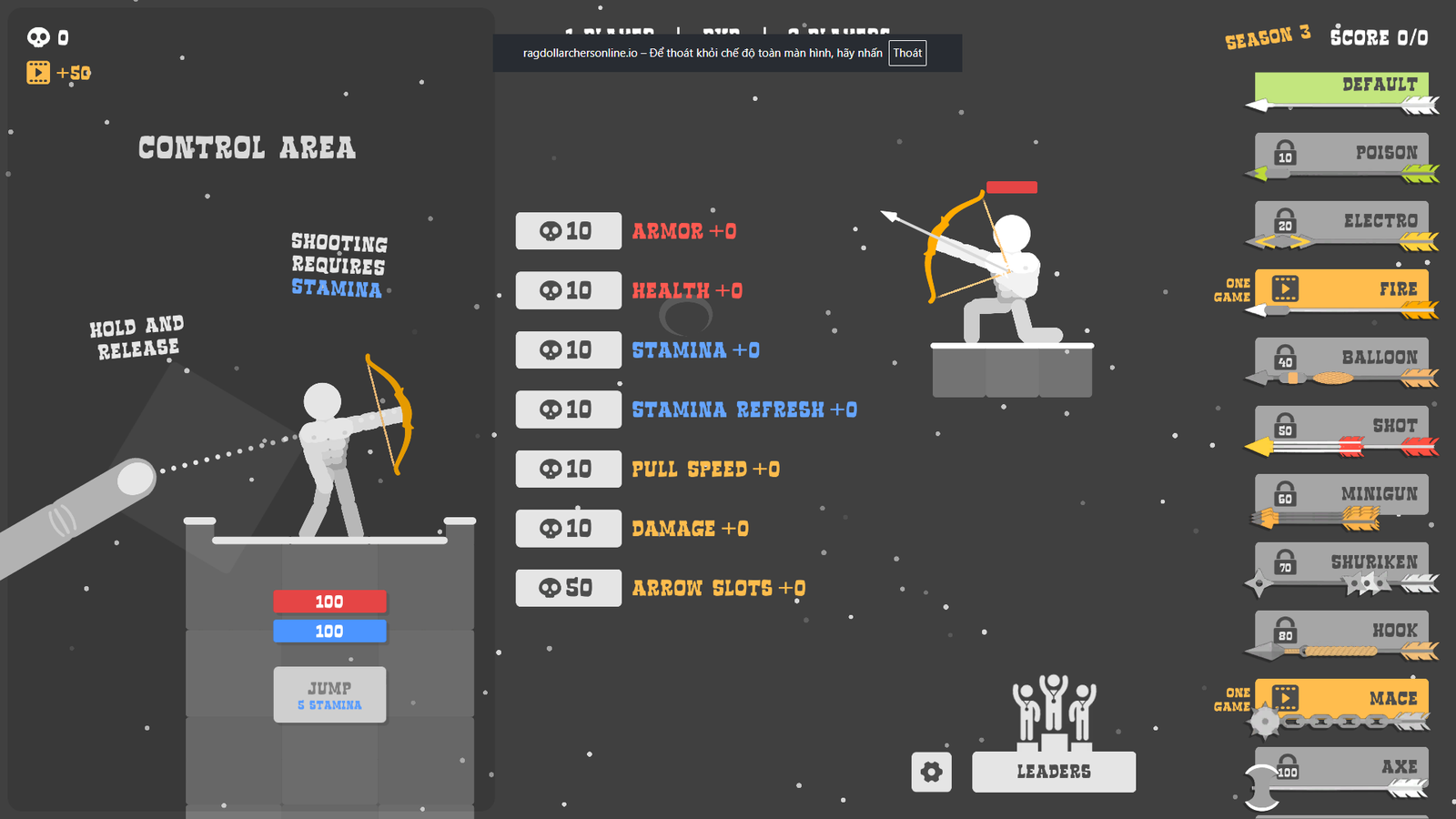
I clicked into Ragdoll Archers expecting a quick browser diversion, the kind you play for ten minutes and forget. My first shot proved I was wrong. I aimed like I was in a normal archery game—steady, confident—and then my archer’s movement did this loose, goofy ragdoll thing that made the whole situation feel half-controlled and half-chaos. The arrow went where I thought it would, but the fight sure didn’t.
And somehow, that was the fun of it. Not because I was good (I wasn’t), but because I couldn’t fully predict what would happen next.
Playing Ragdoll Archers feels like aiming through a joke
So Ragdoll Archers is a physics-based archery combat game, and you can tell immediately. The ragdoll movement isn’t just decoration—it actively messes with your timing. Enemies shift, your character bounces, and suddenly the “perfect angle” you were lining up turns into something else the moment you move.
Single Player is where I started, facing continuous enemies and trying to stay alive as long as possible. It’s not a puzzle where you figure out the pattern and coast. It’s more like: shoot, react, manage yourself, repeat. The aiming controls are simple enough to understand quickly (mouse, aim, release, jump), but the gameplay doesn’t stay simple for long. As the fight goes on, you start paying attention to things you didn’t notice at first—like how long you hold your aim, how much stamina you’re burning, and how exposed you are after you fire.
My early rounds were a mess in the most entertaining way. I’d rush the shot, miss, then panic-jump to recover position—only to realize jumping and aiming for too long both cost stamina. By the time I tried to “seriously focus,” my health and stamina bars were already in trouble.
Health, stamina, and apples: the real boss fight
The game keeps you honest with health and stamina. Health is pretty straightforward: take damage, and you’re closer to ending the run. Stamina is trickier because it changes how you play. When stamina gets low, your movement and actions feel less forgiving, and suddenly even an enemy that seemed easy at the start can punish you.
Then the apples show up, and that’s where I started making better decisions. Apples aren’t just a bonus—they’re a strategy you learn by failing. I honestly didn’t expect them to matter as much as they do. In my second or third run, I ignored an apple because I was trying to finish an enemy fast… and got hit right after. After that, I started treating apples like lifelines. Red apples help restore health, green apples restore stamina, and golden apples restore both. Hitting them at the right time often felt safer than forcing another risky shot.
Skulls, upgrades, and unlocking new arrows
Defeating enemy archers earns skulls, and those skulls are what push your progress. Instead of the game just getting harder forever, you improve your archer. I liked that the upgrades weren’t only about damage. There’s a real sense of “fix your biggest problem,” whether that’s survivability, stamina, or the ability to end fights quicker.
I also noticed new arrow types become available as you progress. That surprised me in a good way. Once you unlock different ammunition—electric, poison, balloon, axe, and more—you start experimenting instead of sticking to one “best” shot. Some enemies felt like they demanded a certain approach, and I’d catch myself thinking, “Okay… this run needs a different arrow.”
What surprised me most about Ragdoll Archers
Honestly? How quickly I went from “I can’t aim” to “I need to survive the next ten seconds.” The ragdoll physics are funny, but they also create pressure. Your character doesn’t behave like a perfectly controlled stickman archer, so you’re constantly adapting—choosing when to commit, when to jump, and when to back off for an apple.
Also, I didn’t expect myself to want to upgrade and replay so soon. Every run feels slightly different because positioning, timing, and enemy pressure won’t line up the same way twice.
A few personal tips (from my own mistakes)
The biggest thing I learned: don’t treat aiming like it’s free. Holding your aim too long drains stamina, and when you’re low, it’s harder to correct your positioning.
Second: when your bars are low, don’t stubbornly “finish the fight.” I kept doing that early on, and it cost me. Apples can turn a losing moment into a reset.
Third: spend skulls based on what’s killing you. Early upgrades felt less exciting than just trying to shoot better, but the runs where I improved my survivability were the ones that actually lasted.
And if you try multiplayer—PvP or 2 Player / co-op—you’ll notice how different the pressure feels when a second archer (on the same screen) changes the whole flow.
Conclusion
After a handful of runs, I get it: Ragdoll Archers isn’t about being perfect—it’s about staying alive long enough to learn. The ragdoll chaos, the constant attention to health and stamina, and those skull-driven upgrades make it weirdly addictive. If you’re looking for a browser game that’s genuinely fun and doesn’t take itself too seriously, I’d say give Ragdoll Archers a try—and if you can, play together with a friend. You’ll both see the same “how did that happen?” moments… and probably both start saying, “Okay, one more round.”

 English
 Arabic
 French
 Spanish
 Portuguese
 Deutsch
 Turkish
 Dutch
Dutch
 Italiano
 Russian
 Romaian
 Portuguese (Brazil)