
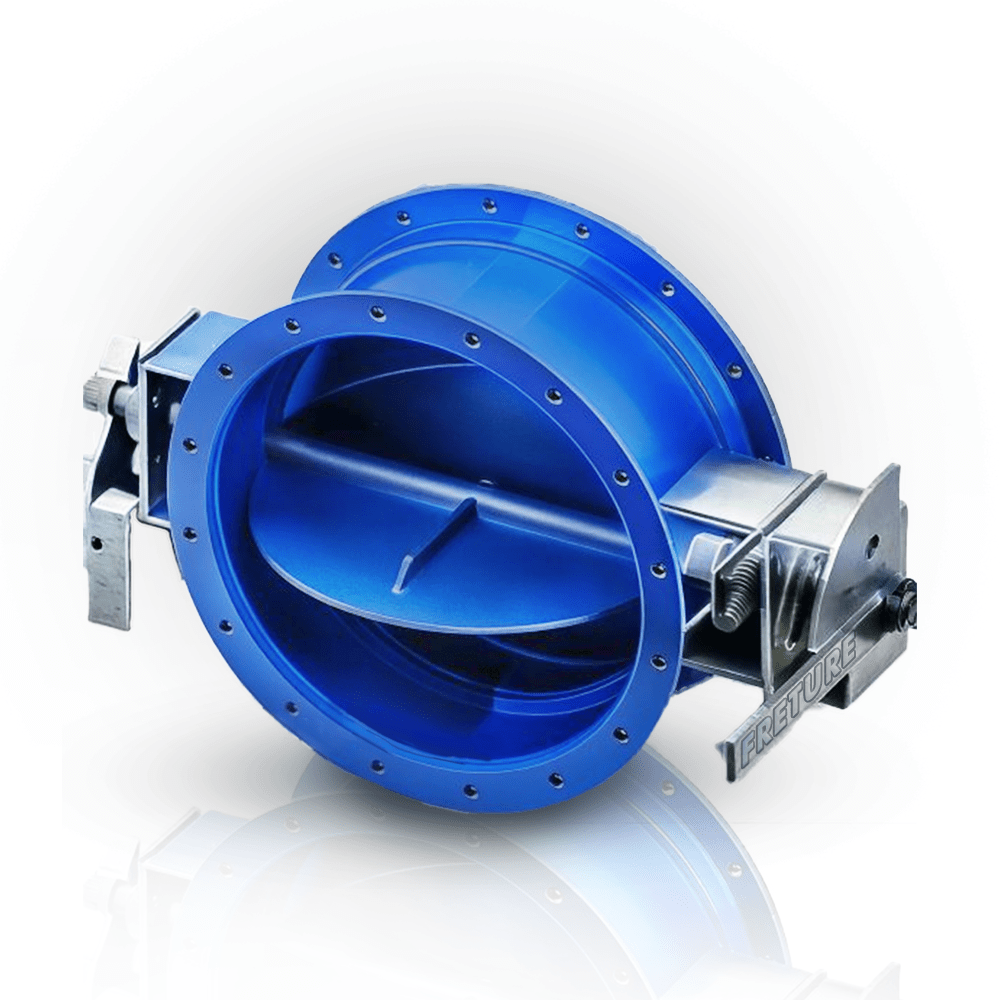
A butterfly damper is an industrial airflow control device used to regulate, modulate, or isolate the movement of air and gases through ducts, ventilation systems, exhaust systems, and industrial process equipment. It generally consists of a circular disc mounted on a rotating shaft inside a frame or body. By rotating the disc, the opening through which air or gas passes can be increased, reduced, or completely closed. Butterfly dampers are widely used where reliable air flow control, gas flow control, and duct isolation are required.
How Does a Butterfly Damper Work?
The working principle of a butterfly damper is based on the rotation of a disc around a central shaft. When the damper is fully open, the disc rotates into a position that offers minimum obstruction to airflow. As the disc rotates, it gradually restricts the passage and controls the volume of air or gas flowing through the system.
A butterfly damper can operate in three basic positions: fully open, partially open, and fully closed. A partially open position allows the damper to perform airflow regulation or modulation, while the closed position is generally used for isolation. Depending on the application, the disc can be operated manually or through an actuator.
Types of Butterfly Dampers
Industrial butterfly dampers are available in different configurations depending on operating requirements.
Manual Butterfly Damper: A manual damper is operated using a hand lever, handwheel, or other mechanical arrangement. It is suitable for applications where frequent automatic adjustment is not required.
Pneumatic Butterfly Damper: Pneumatic actuators use compressed air to rotate the damper shaft. They are suitable for industrial processes requiring fast and automated operation.
Electric or Motorized Butterfly Damper: Electric actuators provide automated opening, closing, or modulating control. They are commonly used when the damper needs to be integrated with an industrial control system.
Butterfly dampers can also be manufactured using materials such as carbon steel and stainless steel, depending on temperature, corrosion, and process conditions.
Butterfly Damper Applications
Butterfly dampers are commonly installed in systems where air or gas needs to be controlled or isolated. Typical applications include:
- HVAC and industrial ventilation systems
- Power generation plants
- Exhaust and flue gas systems
- Petrochemical and process industries
- Oil and gas facilities
- Dust collection systems
- Environmental pollution control equipment
- Industrial furnaces and combustion systems
- Fans and ducting systems
For high-temperature applications, specialized materials, seals, bearings, and construction methods may be required.
Butterfly Damper Specifications
The correct butterfly damper design depends on the requirements of the application. Important specifications may include damper size, material, operating temperature, pressure, airflow velocity, sealing arrangement, actuator type, and required shutoff performance.
Industrial butterfly dampers can be manufactured in round, square, or rectangular configurations. Freture Techno supplies butterfly dampers in sizes ranging from 6 to 144 inches, with selected high-temperature designs capable of handling temperatures up to 2200°F, depending on construction and application requirements.
Benefits of Butterfly Dampers
A properly selected butterfly damper offers several advantages for industrial air and gas systems:
- Compact and practical design
- Effective airflow regulation
- Suitable for large duct sizes
- Manual and automated operation
- Modulating or open/close control
- Different sealing options
- Availability in carbon steel and stainless steel
- Options for high-temperature applications
- Easy integration with industrial actuators
Butterfly Damper Manufacturer in India
Freture Techno Pvt. Ltd. is a butterfly damper manufacturer in India offering industrial dampers for air and gas flow control applications. The company provides manual, electric, and pneumatic configurations along with different materials, sizes, sealing arrangements, and customized designs based on project requirements.
When selecting a butterfly damper, factors such as duct size, flow medium, temperature, pressure, airflow velocity, material compatibility, actuator requirements, and shutoff requirements should always be considered. Choosing the correct design helps improve system performance, reliability, and operational control.

 Arabic
 French
 Spanish
 Portuguese
 Deutsch
 Turkish
 Dutch
Dutch
 Italiano
 Russian
 Romaian
 Portuguese (Brazil)
 Tiếng Việt