
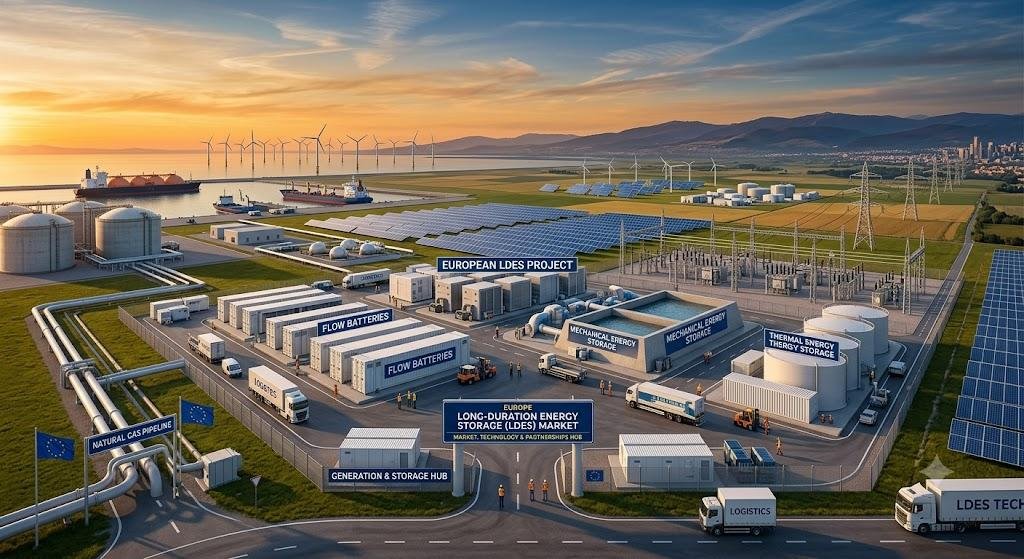
Europe Long-Duration Energy Storage Market Outlook: Technologies, Revenue and Investment
Europe Long-Duration Energy Storage (LDES) Market is entering a period in which investment decisions are becoming more sophisticated. Early discussions often focused on technology performance and the broad need for storage. Today, stakeholders are paying greater attention to revenue quality, grid access, contracting structures, and the ability of a project to operate within evolving electricity markets. This shift is important because long-duration storage creates value only when its physical capabilities can be converted into dependable commercial outcomes.
The strongest demand drivers are linked to renewable integration. Wind and solar generation can create periods of surplus electricity followed by intervals of lower production. As these patterns become more significant, power systems need resources capable of shifting energy beyond the narrow windows addressed by conventional short-duration batteries. LDES can potentially support evening demand, prolonged renewable shortfalls, peak capacity requirements, and recovery from unexpected system conditions.
The investment case also varies by duration. Systems designed for four to eight hours can target daily energy shifting and renewable firming. Longer systems may address multi-day events, prolonged weather patterns, or strategic reserve requirements. Very long-duration solutions can serve seasonal applications where electricity must be stored over substantially longer periods. This creates several market segments rather than a single LDES category, with each segment requiring different technologies, commercial structures, and performance expectations.
Revenue stacking is another important consideration. A project may combine energy arbitrage with balancing services, capacity payments, network support, or bilateral contracts. However, investors should avoid assuming that every possible revenue stream can be captured simultaneously. Market rules, dispatch priorities, availability requirements, and competition can limit the practical value of stacking. A strong financial model should therefore distinguish between contracted base revenue and merchant upside, while testing downside scenarios for weaker spreads, lower utilization, and changing market participation rules.
Grid location can be just as important as technology. Transmission congestion can increase the value of flexible assets, but constrained regions may also introduce connection delays and operational uncertainty. Developers need to understand whether a project can secure a viable connection, when energization may occur, and how local network conditions could influence dispatch. A project located near renewable generation, demand centers, or constrained transmission infrastructure may offer greater system value than an identical project in a less stressed location.
Policy is gradually becoming a stronger influence on bankability. Mechanisms that reward availability, reliability, or flexibility can reduce dependence on volatile merchant revenues. The European policy environment is moving toward greater recognition of flexibility, while individual national markets continue to develop their own approaches. The UK’s evolving cap-and-floor model is a prominent example of efforts to provide greater revenue certainty for long-duration assets, while other markets are exploring capacity and procurement mechanisms.
For stakeholders evaluating the Europe Long-Duration Energy Storage (LDES) Market, Europe Long-Duration Energy Storage (LDES) Market Report provides a useful framework for thinking about technology pathways, revenue stacks, geography, and execution risks. Market participants should focus on where system need becomes payable value rather than relying on generalized storage demand. That distinction can determine whether a project progresses from concept to financing.
The next stage of Europe’s LDES development will favor commercially disciplined projects with clear operating strategies and credible financing structures. Utilities, developers, technology providers, and investors will need to coordinate around measurable performance, reliable connections, and clear contractual responsibilities. Projects that combine appropriate duration with strong operational controls and resilient revenue structures should be positioned to attract capital. As Europe builds a cleaner and more variable electricity system, LDES can become an essential flexibility resource, but the strongest opportunities will be supported by credible economics, practical execution, and measurable system reliability outcomes.

 Arabic
 French
 Spanish
 Portuguese
 Deutsch
 Turkish
 Dutch
Dutch
 Italiano
 Russian
 Romaian
 Portuguese (Brazil)
 Tiếng Việt