
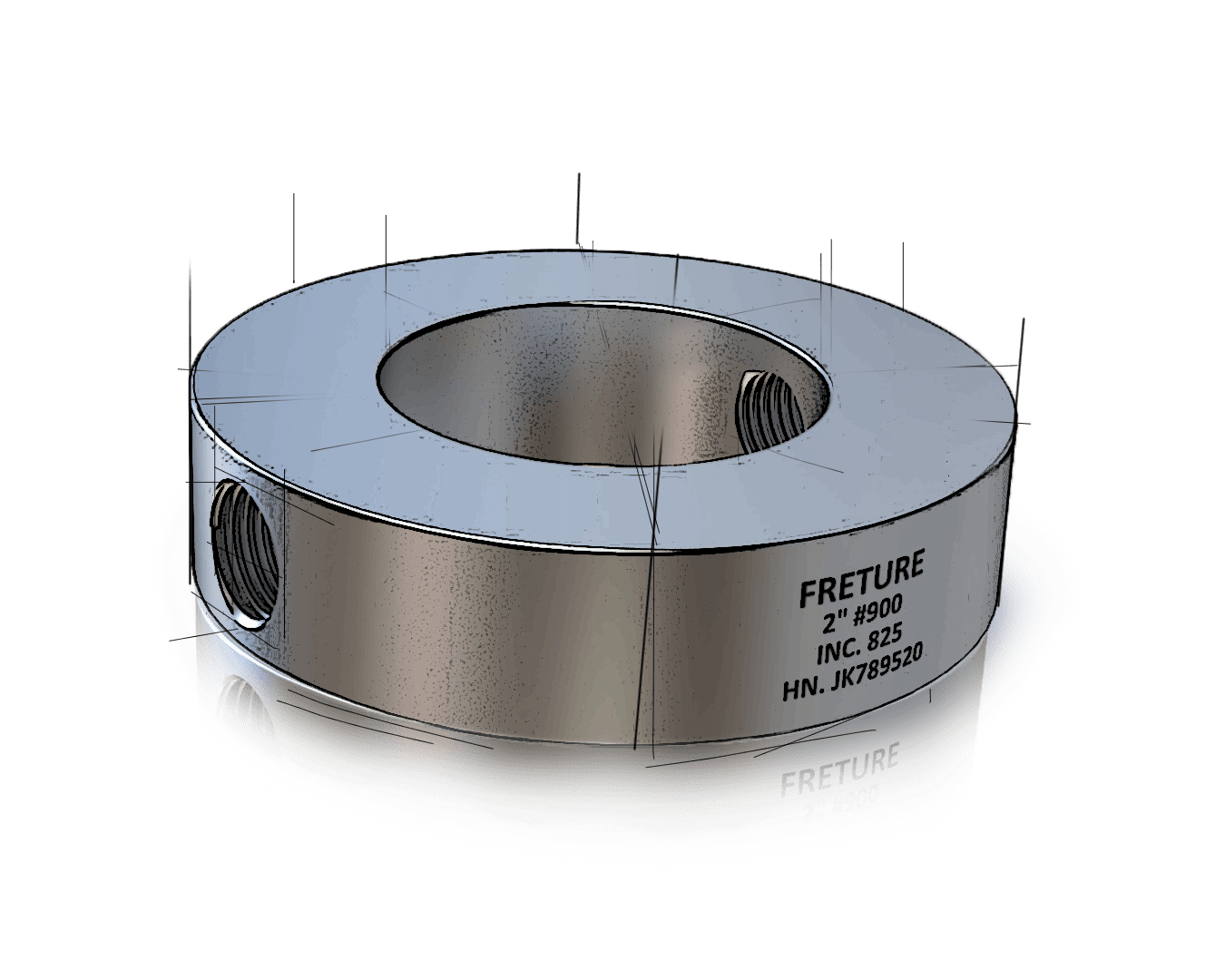
Pressure instruments rarely fail because the process itself is unmeasurable — they fail because the instrument wasn't protected from what the process throws at it: heat, pulsation, viscous media, or solids that coat sensing elements. Two accessories address these problems directly: the pressure gauge syphon, which shields gauges from high-temperature steam, and the flushing ring, which allows in-service cleaning of diaphragm seal instruments. Though they solve different problems, both exist to keep pressure measurement accurate over the long term without constant instrument replacement.
Part 1: Pressure Gauge Syphon
What Is a Pressure Gauge Syphon?
A pressure gauge syphon (also spelled siphon) is a coiled or looped section of tubing installed between a hot process connection — typically steam — and a pressure gauge. It's often referred to by its shape: pigtail syphon, coil syphon, or ram's horn syphon.
Working Principle
The syphon's loop naturally traps condensate as steam passes through it. This trapped liquid acts as a thermal barrier and pressure-transmitting medium between the hot process and the gauge's Bourdon tube. Rather than live steam contacting the gauge's internals directly, the condensate absorbs and buffers the heat, protecting sensitive gauge components from thermal stress while still transmitting process pressure accurately.
This is a simple, passive, maintenance-light solution — the syphon has no moving parts and relies purely on its geometry and gravity to keep condensate in place.
Types of Pressure Gauge Syphons
- Pigtail syphon – a coiled, spring-like loop; the most common configuration for steam gauge protection
- Ram's horn syphon – a U-shaped or looped tube, often used where space or orientation limits a full coil
- Straight coil syphon – a compact spiral form for tighter installation spaces
Applications
- Steam pressure gauges on boilers and steam headers
- High-temperature process lines where direct contact would damage gauge internals
- Any application where pulsation or thermal shock needs to be dampened before reaching the gauge

Material and Sizing
Syphons are commonly manufactured in carbon steel or stainless steel (SS316), matched to the pressure and temperature rating of the connected gauge and process. Connection sizes typically mirror standard gauge threads (¼" or ½" NPT/BSP).
Part 2: Flushing Ring
What Is a Flushing Ring?
A flushing ring is a fitting installed between a diaphragm seal instrument and its process flange connection. It provides additional side ports — usually two, sometimes four — that allow a flushing medium to be introduced around the diaphragm face without disturbing the process or removing the instrument.
Working Principle
The flushing ring sits as a spacer/adapter with internal channels leading to the diaphragm surface. By connecting a flushing fluid supply to these ports, operators can:
- Clean built-up material off the diaphragm face
- Verify or adjust instrument zero/calibration in-situ
- Clear blockages caused by viscous, crystallizing, or slurry-type media
Because flushing happens without removing the seal or interrupting the process connection, it minimizes downtime and reduces the risk of damaging the thin diaphragm during maintenance.

Applications
- Viscous or high-solids process media (slurries, sludges, pastes)
- Crystallizing or solidifying fluids that coat the diaphragm over time
- Food, pharmaceutical, and hygienic processes requiring regular CIP-style cleaning
- Any diaphragm seal application where process fouling is a recurring maintenance issue
Benefits
- In-situ cleaning — no need to unbolt or remove the instrument for routine maintenance
- Extended diaphragm life — reduces mechanical wear from repeated disassembly
- Reduced downtime — flushing can often be performed without a full process shutdown
- Improved measurement reliability — a clean diaphragm responds accurately to pressure changes
Choosing the Right Accessory for the Application
| Accessory | Primary Purpose | Typical Service |
|---|---|---|
| Pressure gauge syphon | Thermal protection of gauge internals | Steam, high-temperature gas/liquid lines |
| Flushing ring | In-line cleaning of diaphragm seals | Viscous, slurry, crystallizing, or hygienic media |
In some installations, both accessories may appear on the same instrument loop — for example, a diaphragm-sealed gauge on a hot, viscous process might use a flushing ring at the process connection and a syphon-style loop upstream of the gauge itself for added thermal protection.
FAQs
Q: Does a pressure gauge syphon need to be filled with liquid before startup? Ideally yes — pre-filling the syphon with water or condensate ensures the thermal barrier is in place from the moment steam enters the line, rather than waiting for condensation to accumulate naturally.
Q: Can a flushing ring be retrofitted to an existing diaphragm seal instrument? In most cases yes, provided the ring is matched to the existing flange size and rating; it's installed between the seal and the process flange during a scheduled maintenance window.
Q: How often should a flushing ring be used to clean the diaphragm? This depends entirely on the process — highly fouling media may require frequent flushing (daily or weekly), while cleaner services may only need occasional flushing during scheduled maintenance.
Q: Is a pressure gauge syphon the same as a pulsation dampener? No — a syphon's primary role is thermal protection through condensate buildup, while a pulsation dampener specifically absorbs pressure spikes and oscillations. Some syphon geometries provide a secondary dampening effect, but they aren't interchangeable by design intent.
Conclusion
Both the pressure gauge syphon and the flushing ring solve a common underlying problem in instrumentation: keeping sensitive measuring elements functional despite harsh process conditions. The syphon protects against heat, the flushing ring protects against fouling — and together, they represent the kind of low-cost, high-value accessories that extend instrument life and reduce unplanned maintenance across a plant. We are leading instrumentation accessories manufacturers in India, contact us to get more information.

 Arabic
 French
 Spanish
 Portuguese
 Deutsch
 Turkish
 Dutch
 Italiano
 Russian
 Romaian
 Portuguese (Brazil)
 Tiếng Việt