
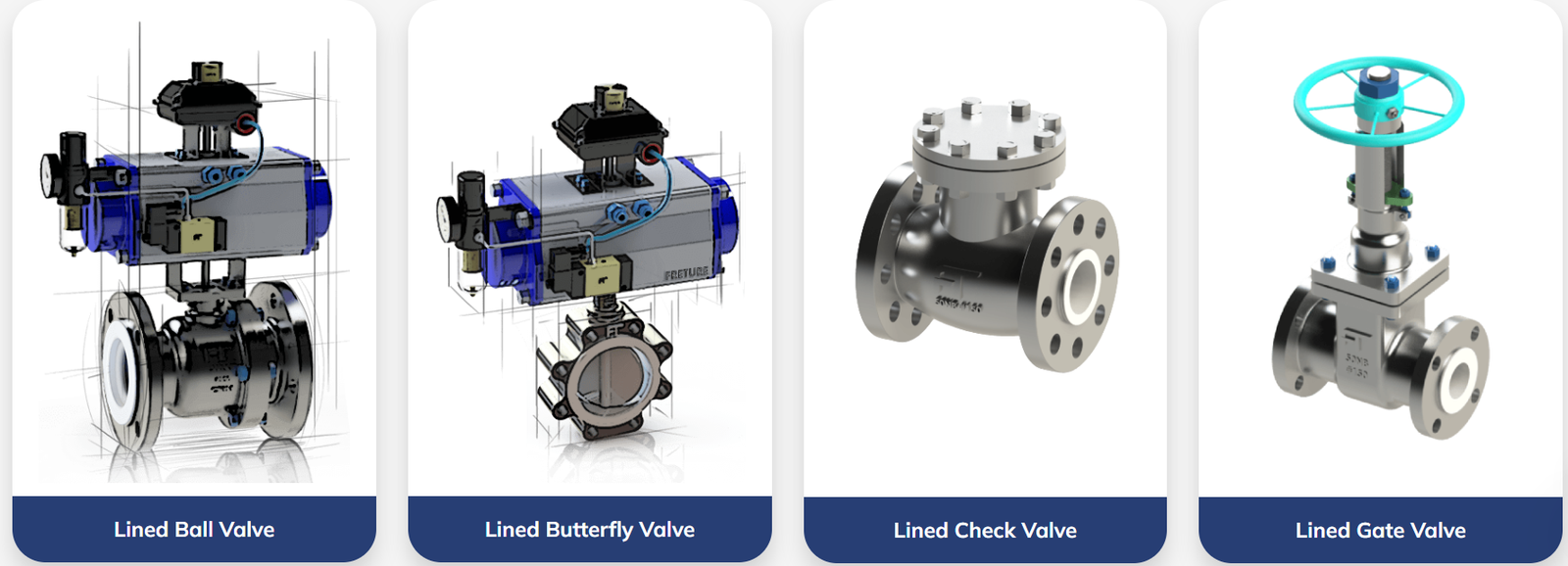
What Makes a Valve "Teflon Lined"?
A teflon lined valve consists of a metal body — typically ductile iron, carbon steel, or stainless steel — with an internal barrier of PTFE bonded or compression-molded into every wetted surface. The metal shell provides structural strength and pressure containment; the lining provides the chemical barrier. Neither material alone would work well for aggressive, corrosive process fluids: solid PTFE lacks the mechanical rigidity to hold a pressure boundary, and an unlined metal body would corrode on contact with strong acids, chlorides, or oxidizers. The lined construction lets engineers specify a low-cost carbon steel body for strength while relying on the fluoropolymer layer for corrosion resistance — a substantially cheaper approach than specifying exotic alloys like Hastelloy or titanium throughout.
Common Valve Types Available with Teflon Lining
Lining isn't exclusive to one valve style. The most widely specified lined valve configurations include:
- Teflon lined ball valves — full-port or reduced-port designs where the ball, seats, and body cavity are all PTFE-encapsulated; the dominant choice for on/off isolation in corrosive service.
- Teflon lined plug valves — sleeve-type plugs faced entirely in PTFE, favored where slurry or particulate-laden fluids would abrade a ball valve's seating surface.
- Lined butterfly valves — a PTFE-faced disc and liner combination, common in larger line sizes where a ball valve's cost or weight becomes prohibitive.
- Lined diaphragm and check valves — used at lower pressure ratings, typically in gravity-fed or low-differential-pressure corrosive transfer lines.
Each geometry trades off differently between flow coefficient, particulate tolerance, and actuation torque, so the valve type — not just the lining material — should be matched to the specific service.
PTFE vs. PFA vs. FEP: Choosing the Right Lining Material
"Teflon" gets used loosely across three distinct fluoropolymer chemistries, and the differences matter for spec writing:
- PTFE offers the broadest chemical resistance and the highest continuous-service temperature of the three, but it's harder to mold into thin, complex geometries without micro-porosity, which is why a PTFE lined valve spec often calls for isostatic molding on complex ball or plug bodies.
- PFA melt-processes more like a conventional thermoplastic, allowing tighter tolerances and fewer pinholes in complex valve cavities, at a modest reduction in maximum temperature rating versus PTFE. A PFA lined valve is frequently the choice where geometry complexity is the bigger risk than raw temperature.
- FEP is the lowest-cost of the three and adequate for many mid-range acids and solvents, but it has the narrowest temperature ceiling and is generally reserved for less demanding duty.
Selecting between them should follow actual process chemistry and temperature at the valve — not the nominal rating on a datasheet, and not the fluid's rating at ambient conditions. A fluid compatible with PTFE at 20°C can behave very differently at 150°C, so lined valve materials should be checked against worst-case operating temperature, not typical temperature.
Pressure class availability also varies by lining material and manufacturer. Most PTFE lined valve and PFA lined valve product lines are readily available through Class 150, with Class 300 options common in larger established product ranges; beyond that, fewer manufacturers offer lined constructions, and solid alloy starts to become the more practical route regardless of chemical compatibility. It's worth confirming pressure class availability early in the specification process, since a chemically ideal lining material offered only in a lower pressure class than the line requires isn't a usable option.
Where Teflon Lined Valves Outperform Solid Alloy Construction
Solid alloy valves remain the right call for extreme services — very high temperature combined with aggressive chemistry, or where mechanical wear would eventually breach a fluoropolymer lining. But for a large share of corrosive-but-moderate-temperature applications — acid transfer, chlorine dioxide, sodium hypochlorite, many solvent lines — a chemical resistant valve with a fluoropolymer lining delivers equivalent chemical resistance at a fraction of the installed cost, with shorter lead times since lined carbon steel bodies are far more commonly stocked than cast exotic alloys.
The trade-off engineers should weigh going in: lining thickness is finite, so any single upset event that drives the fluid outside the lining's temperature or pressure envelope — a steam-purge excursion, a blocked-in thermal expansion event, a surge from a fast-closing valve elsewhere in the line — can compromise the barrier permanently in a way solid alloy construction would tolerate. Sizing the lining spec against actual upset scenarios, not just steady-state operating conditions, is what separates a reliable installation from a recurring maintenance problem.
Application Fit Across Process Industries
A PTFE lined valve shows up wherever corrosive, non-abrasive fluids move through moderate-pressure, moderate-temperature piping: acid and caustic transfer in chemical processing, chlorine and hypochlorite dosing in water treatment, solvent handling in pharmaceutical intermediates, and pickling-line acid circuits in steel processing. In each of these, the lined valve's role is narrower than a general-purpose isolation valve — it's specifically the corrosion barrier component of the system, and its selection needs to be cross-checked against actual line chemistry, not just the industry vertical it's deployed in.
Desalination and chlor-alkali plants add a further wrinkle worth flagging separately: both handle chlorine and hypochlorite streams where trace contamination from a corroding valve body isn't just a maintenance issue but a product-quality and safety concern. A well-specified lined valve keeps the process fluid isolated from the metal body entirely under normal operation, which is a meaningfully different risk profile than a coated or plated alternative, where the protective layer is typically thinner and more prone to localized breach.
Conclusion
Choosing the right teflon lined valve starts with matching lining chemistry — PTFE, PFA, or FEP — to actual worst-case process conditions, then selecting the valve geometry that fits the flow and particulate profile of the line. Done correctly, this approach gives process plants a corrosion-resistant isolation point without the capital cost of solid exotic alloys. As part of a broader strategy for Teflon lined valves for process industries, this valve family sits alongside solid alloy and lined ball valve options as one of several proven approaches to controlling corrosive service — and getting the lining and material match right at the specification stage is what determines whether it performs for the life of the plant or requires early replacement.

 Arabic
 French
 Spanish
 Portuguese
 Deutsch
 Turkish
 Dutch
Dutch
 Italiano
 Russian
 Romaian
 Portuguese (Brazil)
 Tiếng Việt